PEP ASSET DECLARATIONS WORKFLOW
Last updated: July 22, 2026
Summary
Investigators can use the PEP Environment within Horizons to access an aggregated database of asset declarations from Politically Exposed Persons (PEPs) in 22 jurisdictions in Eastern Europe and Russia, offering a window into their “declared wealth”. Investigators can then search the larger Horizons data lake for any assets that these same PEPs may not have declared.
Problem Statement
Although public PEP asset declarations are intended to increase data transparency and accountability, PEPs sometimes try to hide or obfuscate assets, particularly if those assets are the result of illicit activity. To generate a fuller picture of a PEP’s total assets, investigators have the ability to compare asset declarations in the PEP environment against C4ADS’ Horizons, a data lake that contains over 2 billion public records across 176 jurisdictions.
Assumptions
1. Investigators have access to Horizons.
2. Investigators run searches in a jurisdiction that has publicly available PEP data.
3. PEPs have submitted declarations and own assets in jurisdictions that are covered within Horizons.
Process
Log into Horizons. This is the landing page of the platform.
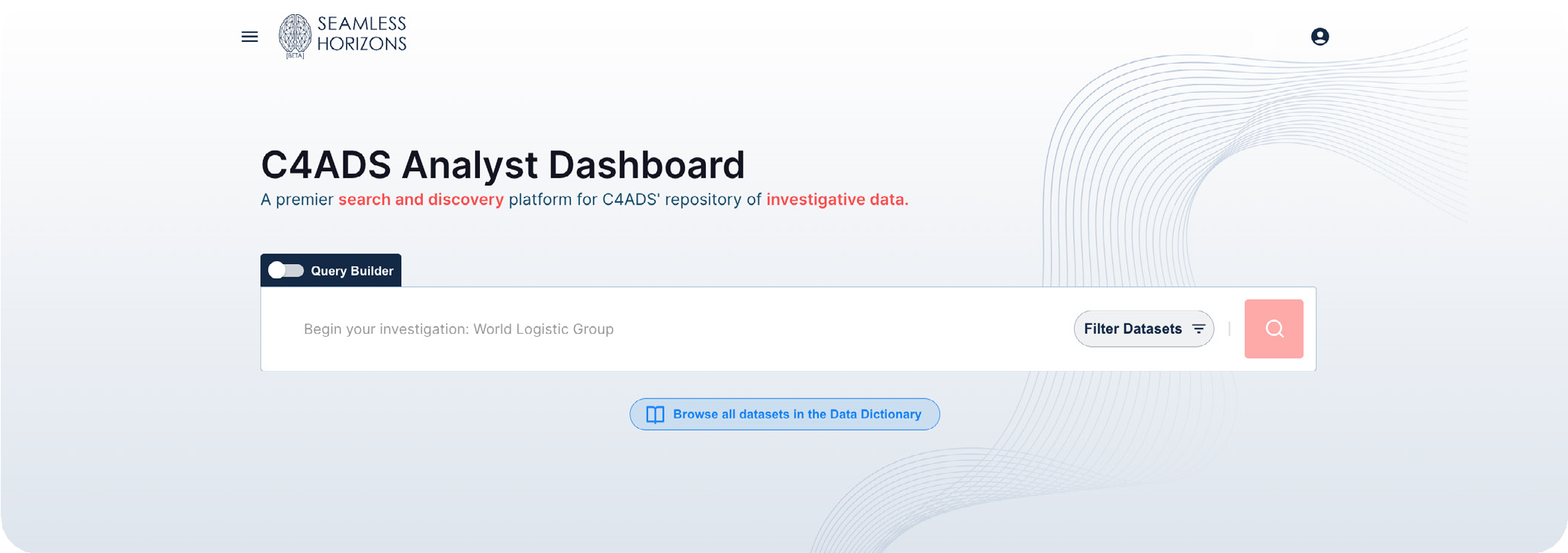
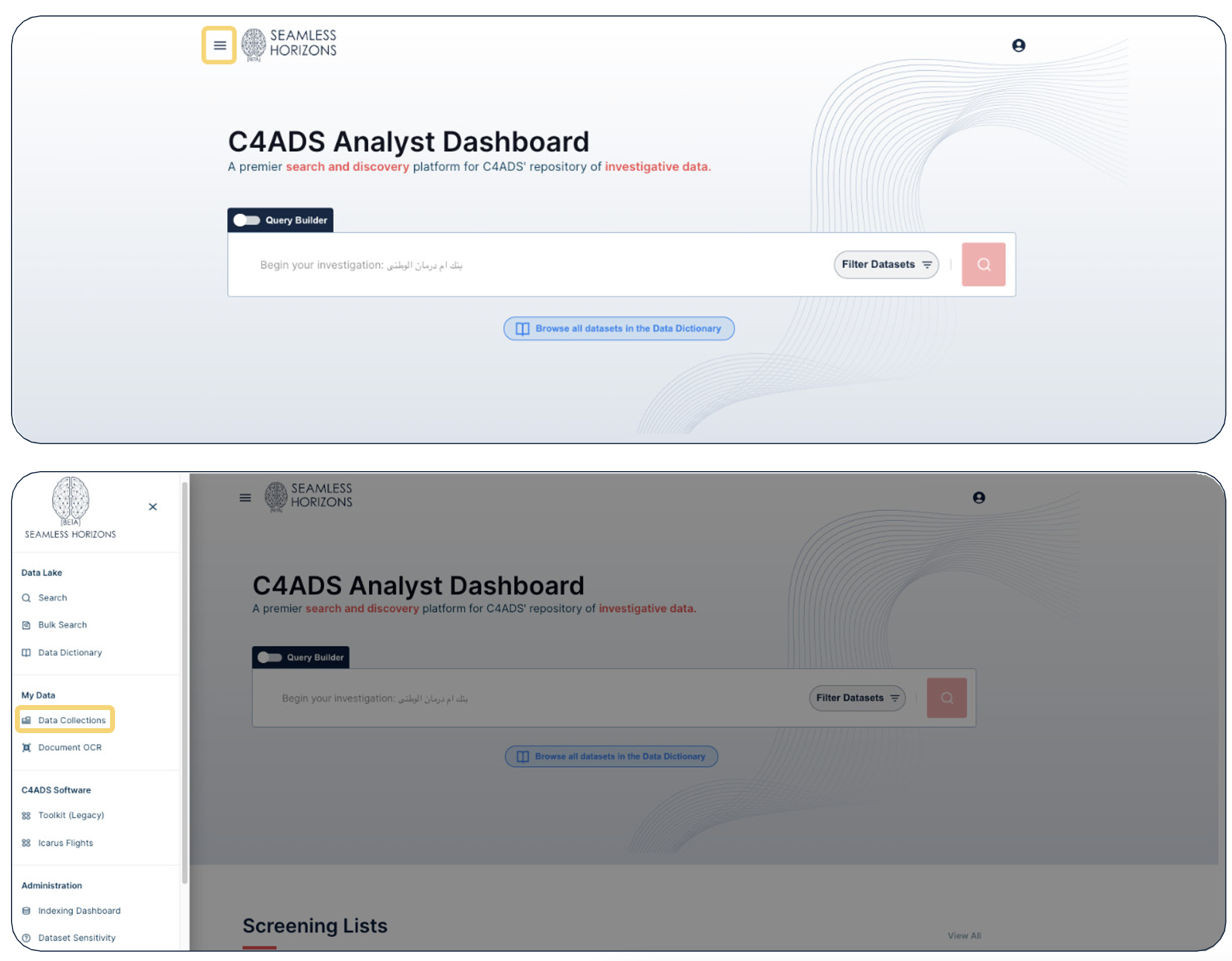
Investigators may want to begin by looking at a PEP’s declared assets. The PEP environment is a specialized data collection within Horizons. To access, go to the landing page. Click on the
3-line menu on the top left and select ‘Data Collections’ under ‘My Data.’ Under the ‘Shared with Me’ tab, click on the Politically Exposed Persons (PEP) data collection to enter into the PEP Environment.
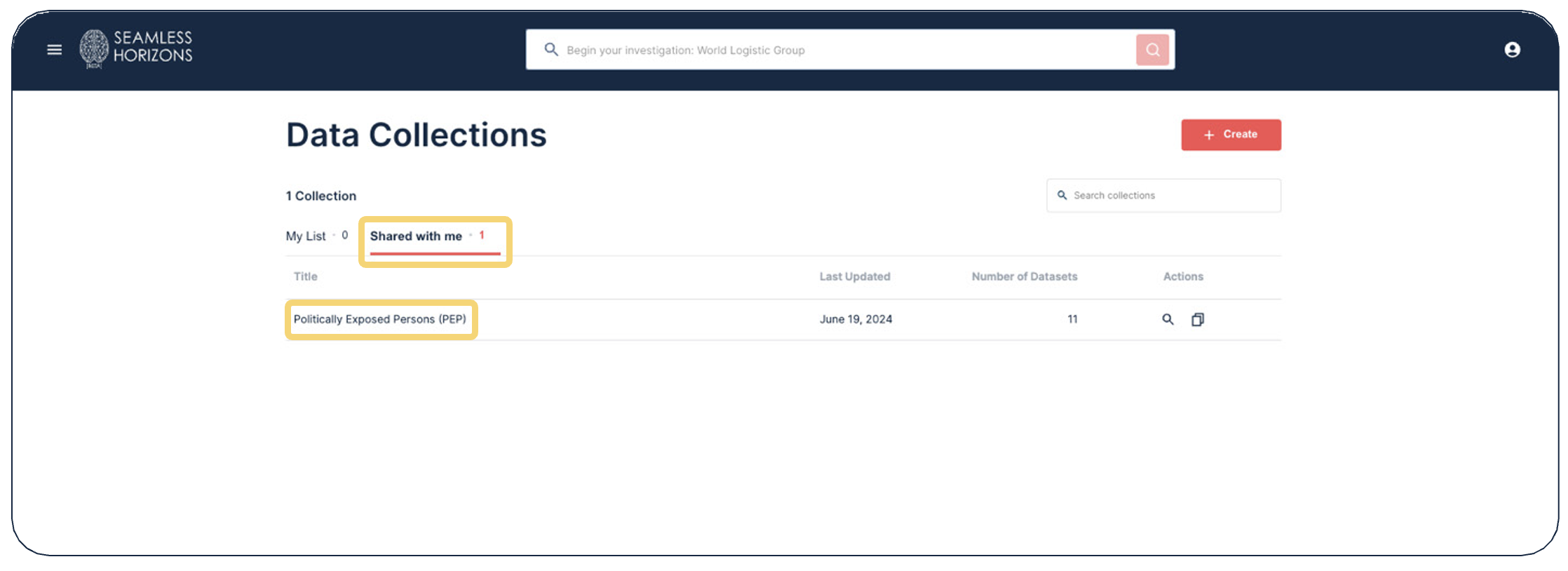
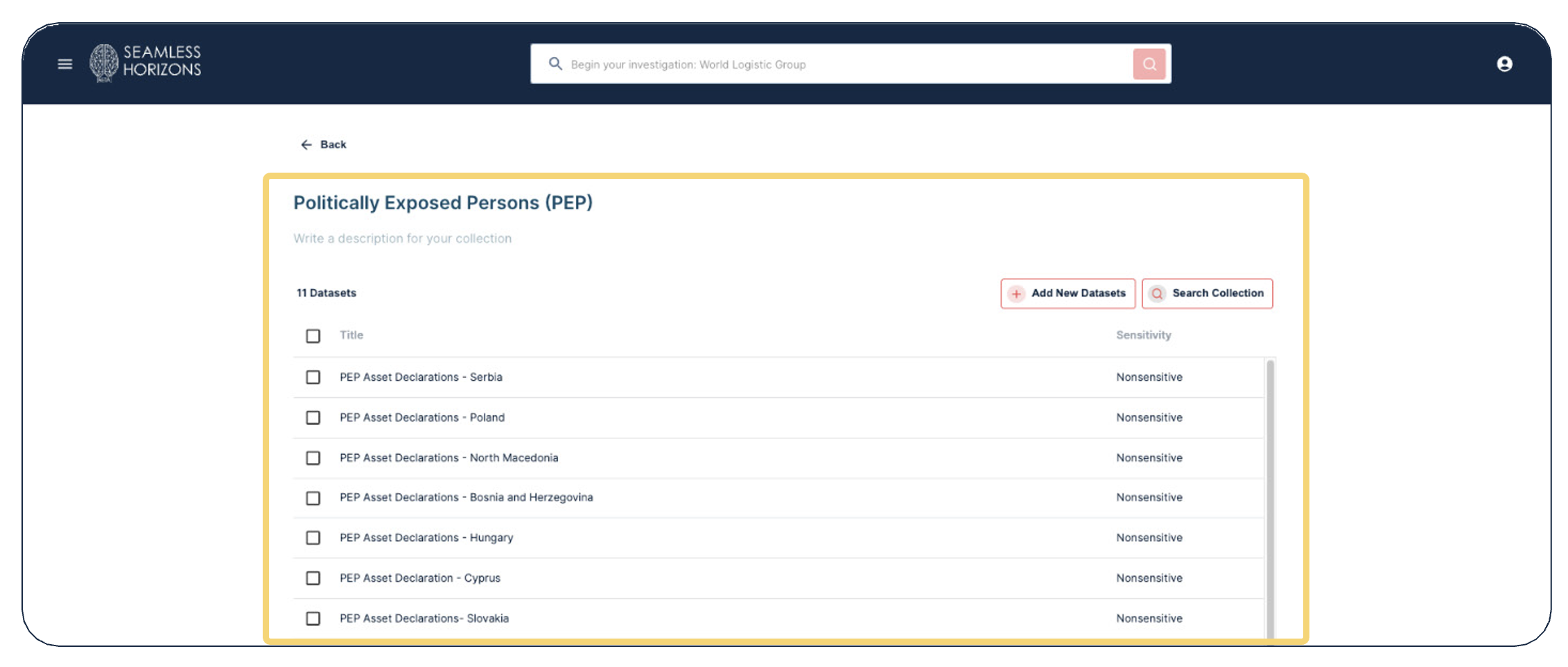
The PEP data collection allows investigators to search all modeled asset declarations in Horizons in one place. Click on “Search Collection” to search these datasets.
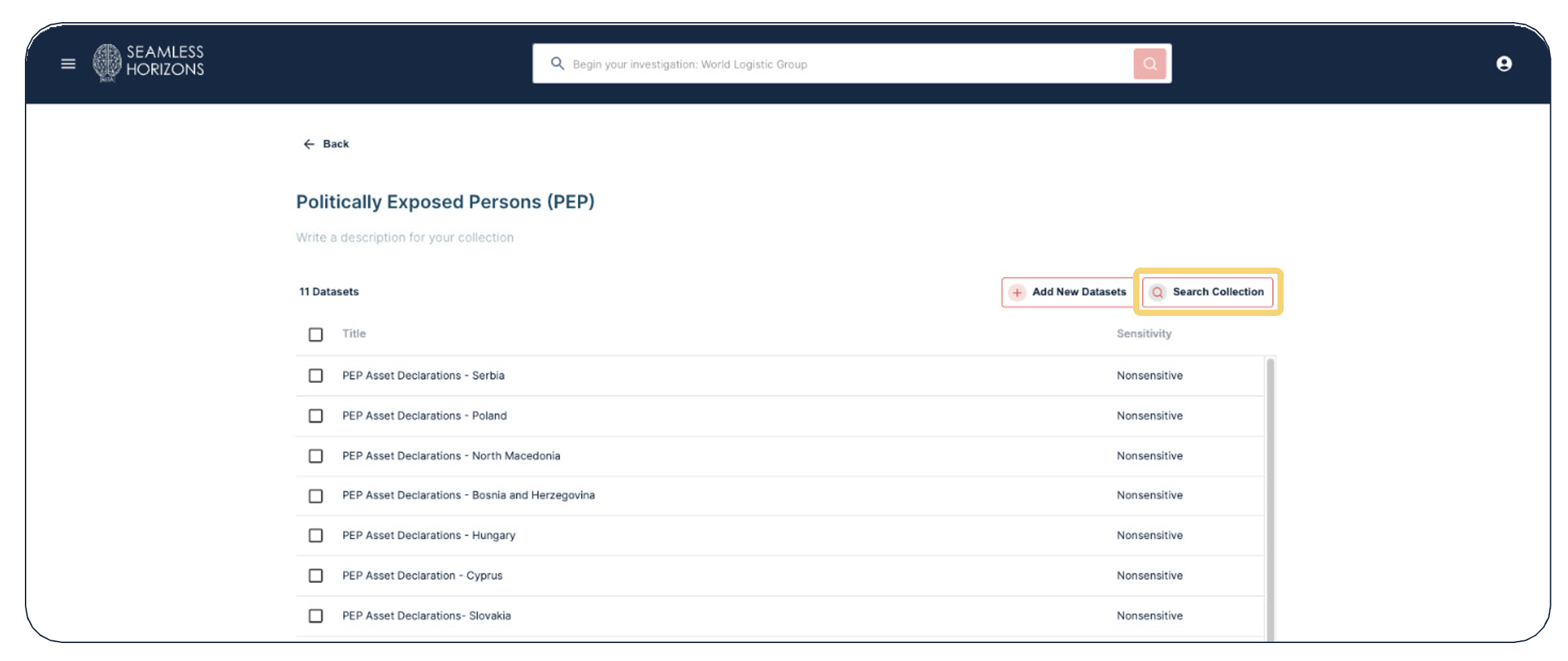
On the left side of the page, investigators can see that datasets from the PEP Environment have been selected. They are now only viewing the PEP Environment inside of Horizons.
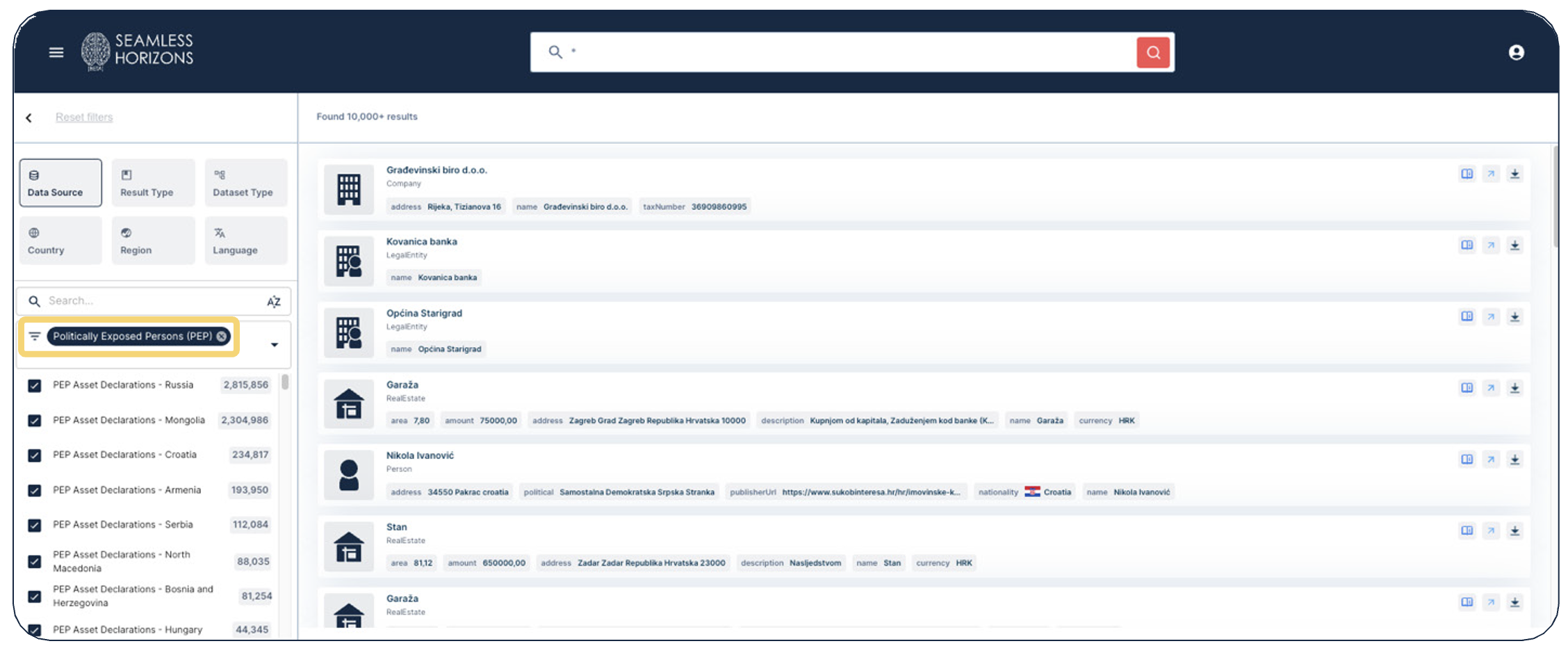
To begin a search, enter your query into the white search bar. The best way to search for a specific PEP in the PEP Environment is to run a fuzzy search for the PEP’s name in the search bar.
a. For this exercise, we will be using Mario Musa, the Chairman of the Board of the Croatian Lottery from October 2017 to April 2022. Mario Musa is being used solely for the purposes of a demonstration. To C4ADS’s knowledge, Mario Musa has not been involved in illicit activity.
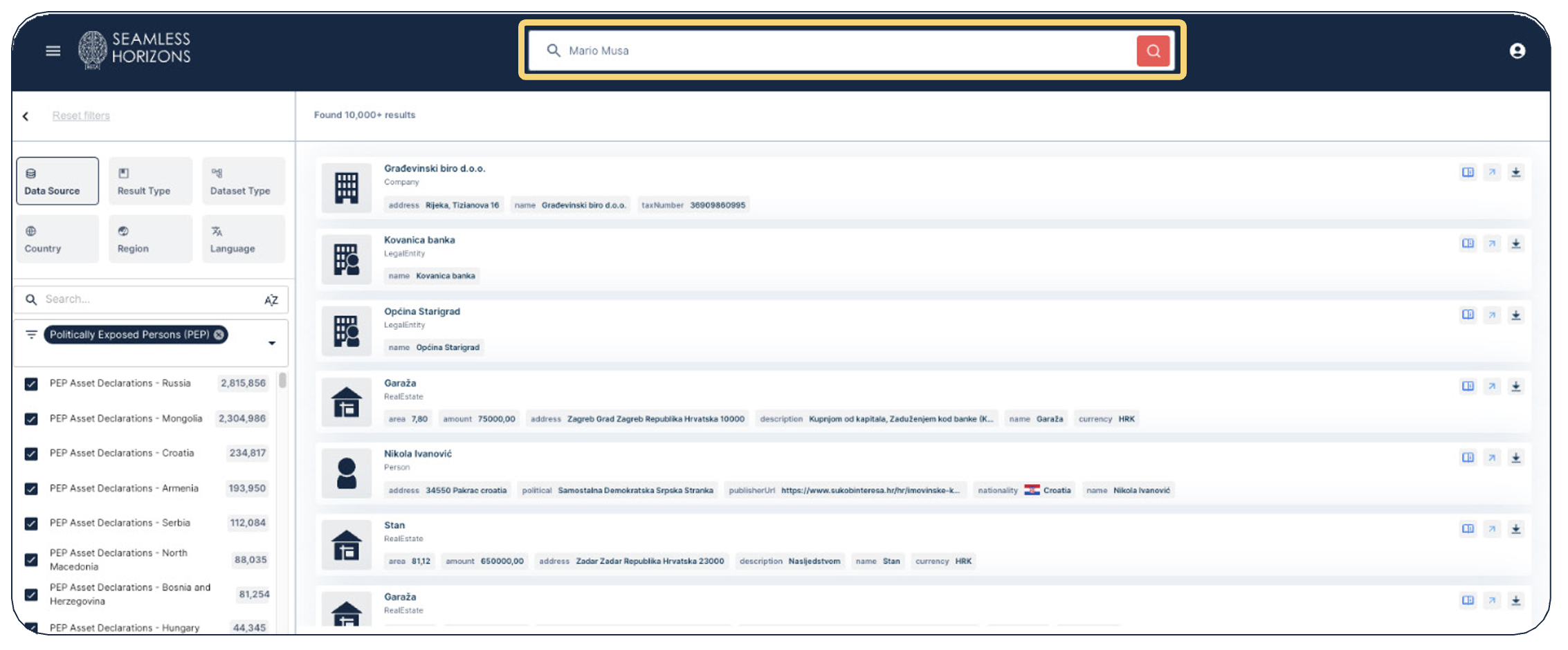
Typing the name of the PEP within quotation marks (“) will give you results that are an exact name match only. If you use quotation marks AND add a tilde at the end (~), you are telling the computer to allow for misspellings, middle names, or the transposition of at least two adjacent characters. Adding a number larger than two after the tilde will allow you to search for larger potential transliteration issues.
Press ENTER or click the red search button. This will lead you to a result page, see below. If the results appear in another language, you can use a Google Translate extension to translate this page.
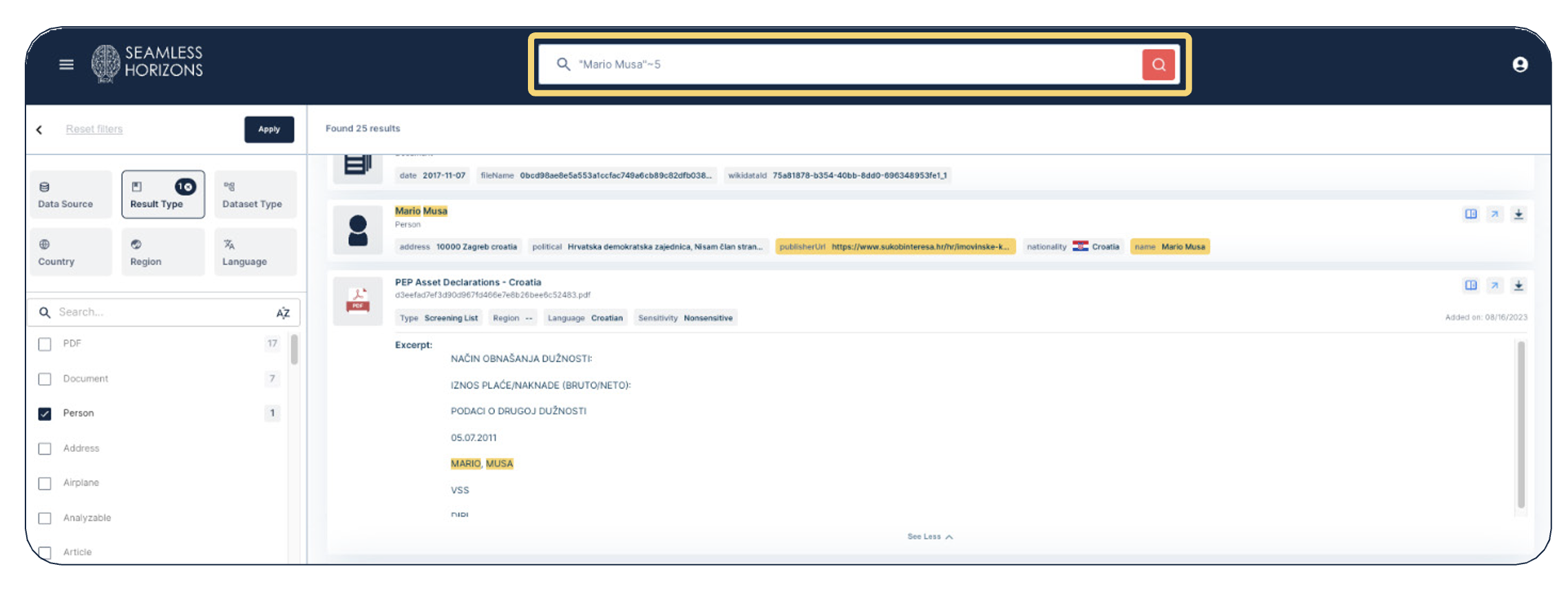
To look only for people who appear in this dataset, select ‘Person’ under ‘Result Type’ and click ‘Apply’. Since the PEP Environment holds modeled data, investigators can view entity cards containing consolidated information about individual people, rather than hundreds of disaggregated rows. This allows for a visually digestible version of the data, assisting investigators in viewing the total amount of information related to the PEP’s asset declarations in a single location.
Investigators can click on the Mario Musa entity card, highlighted in yellow, to examine the official asset declarations he has submitted to the Croatian government. The entity card displays a description table on the right-hand side of the screen.
Each jurisdiction has its own definition of who falls under the category of a Politically Exposed Person and what information they are required to declare. For Croatia, this table includes the PEP’s name, nationality, address and political party. If personal identifiers were included in the asset declaration, they will be noted in the description table. These identifiers may be helpful to investigators when resolving entities (matching two Mario Musa’s that live at the same address, for example).
The description table also includes a link to the original asset declaration. You can use this link to find updated information published by the Croatian government. In conducting their investigations, investigators should keep in mind the legal framework of the jurisdiction in which they are working. Not all jurisdictions consider it a crime if a PEP omits information from their asset declarations --- but some do.
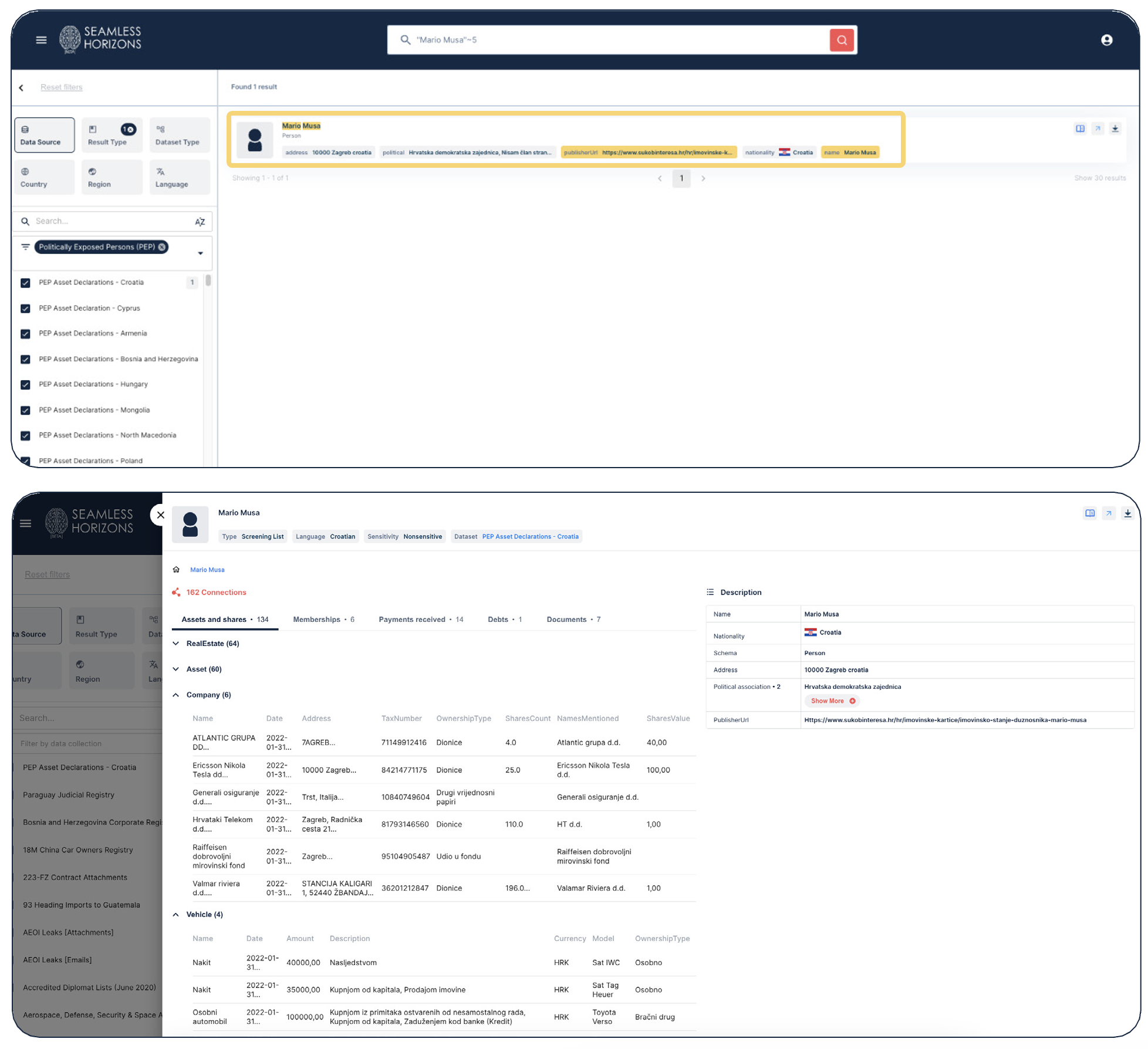
You will note that the entity card also displays declared assets and shares, memberships, payments received, and documents. For a breakdown of what appears under each heading, see below:
Assets and shares
• Cash assets, securities, stock
• Shares in a company
• Real estate and land ownership information
• Vehicles
Membership
• Political position (position for submitting asset declaration)
• Other positions/ memberships in government and private organizations
Payments received
• Declared income
Documents
• Original asset declaration forms
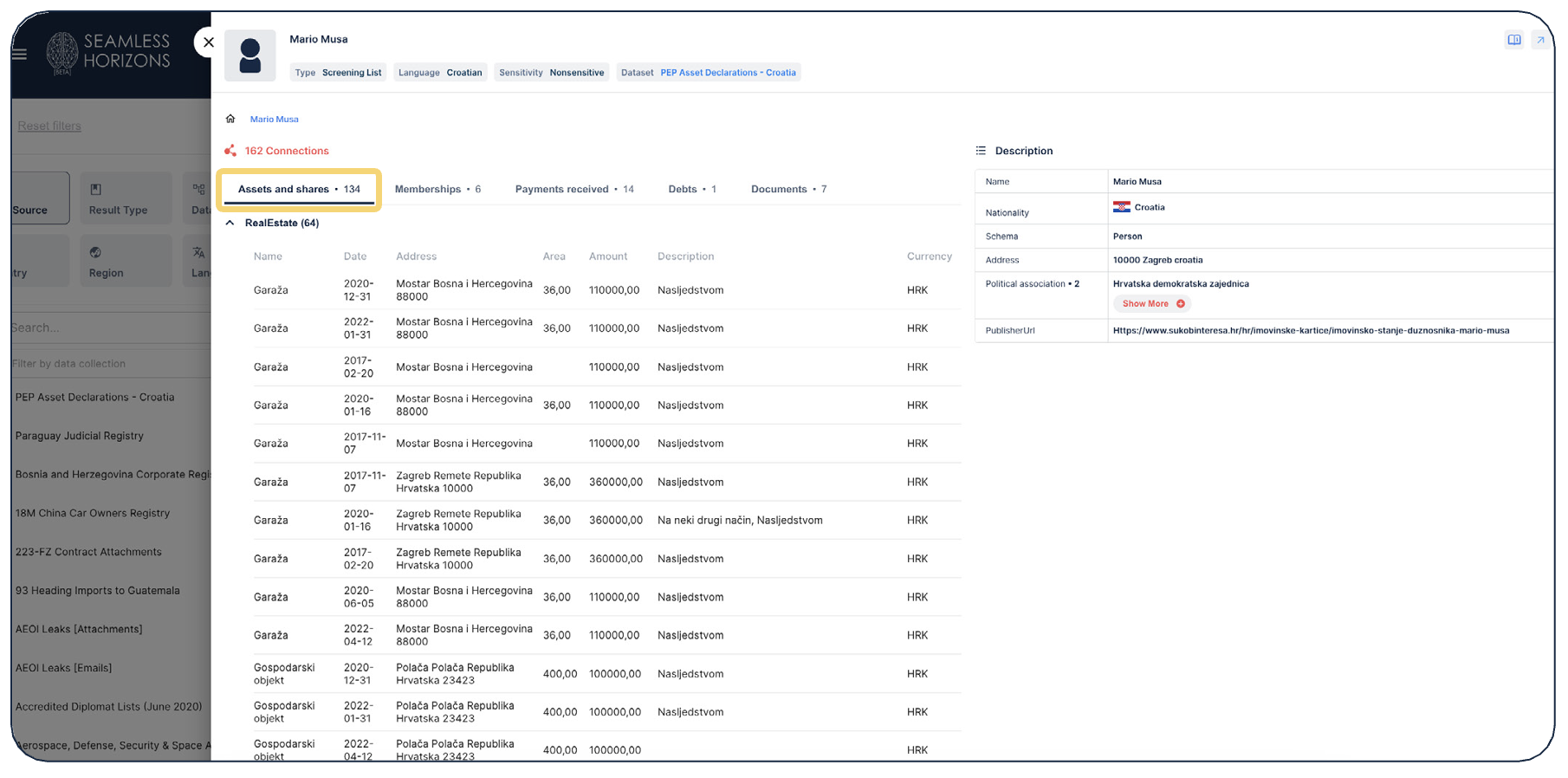
The assets and shares tab allows investigators to collapse assets by subtype to facilitate ease of investigation.
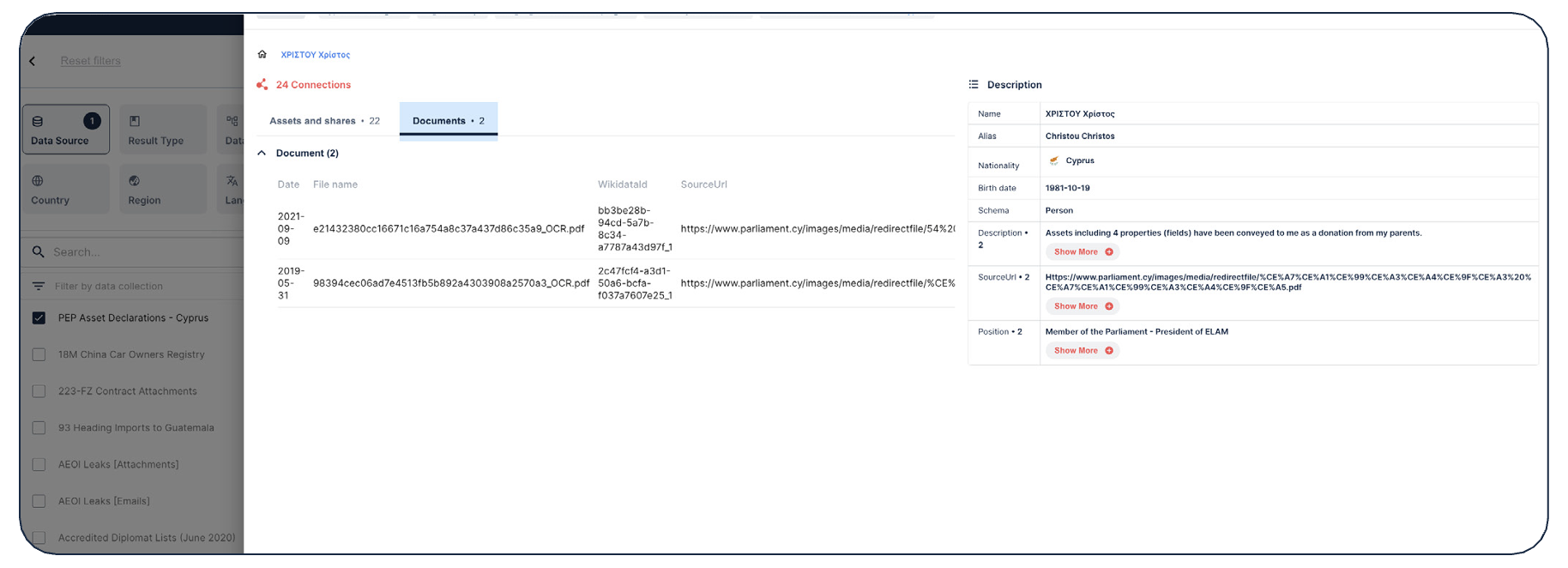
To view each original asset declaration, you can click into the ‘Document’ tab. From the date column, you can see that Musa’s asset declarations were submitted between 2017 and 2022.
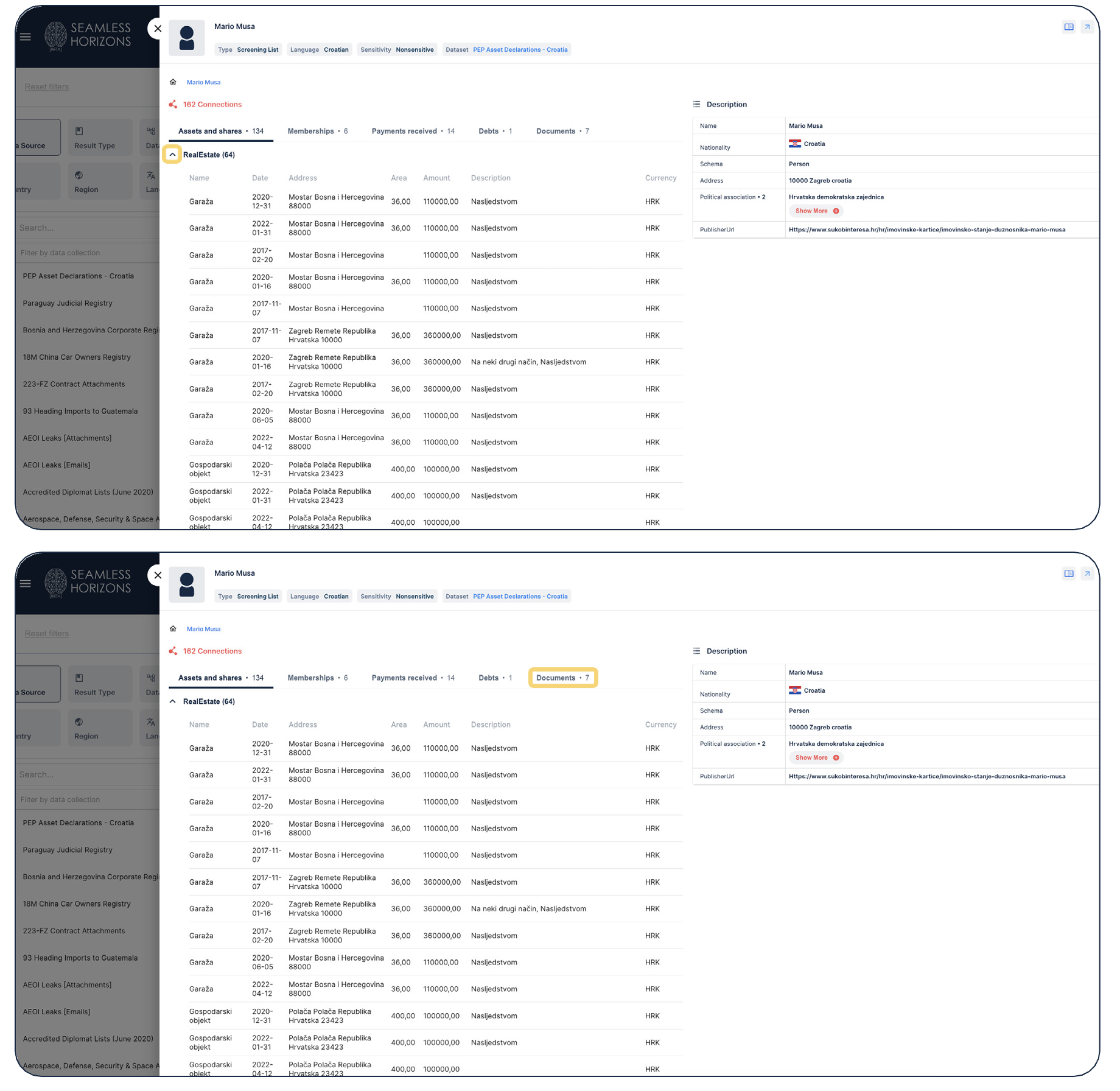
Clicking on the eye icon on the left-hand side of each document row will take investigators to where the original asset declarations live. Investigators can use these documents for their citations. They are interesting to view in their original format, as many are in handwritten form. The legibility of these documents varies greatly, so investigators can compare the original format to the modeled version made available by the Horizons entity card. See below for an example of a hand written asset declaration that has been modeled.
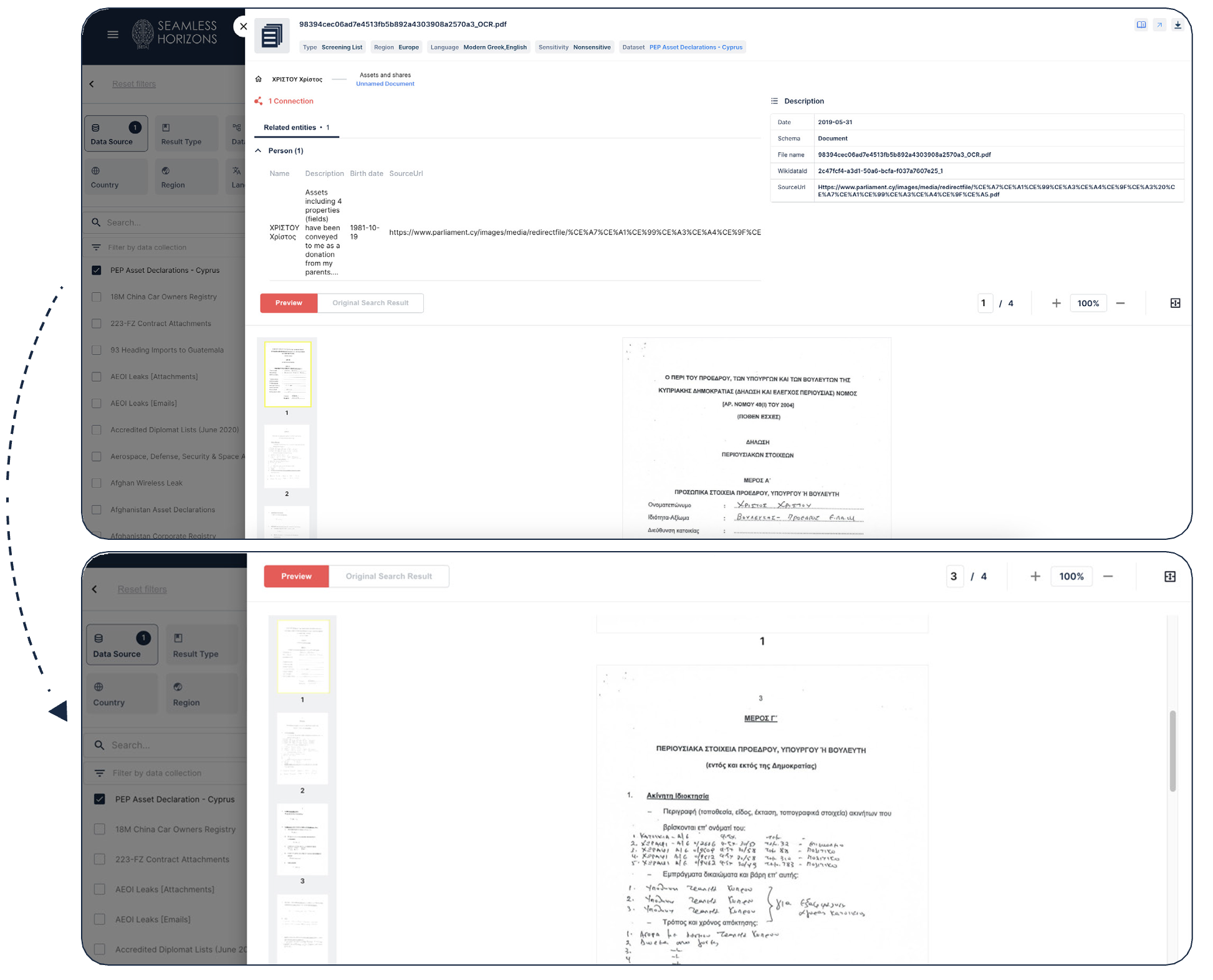
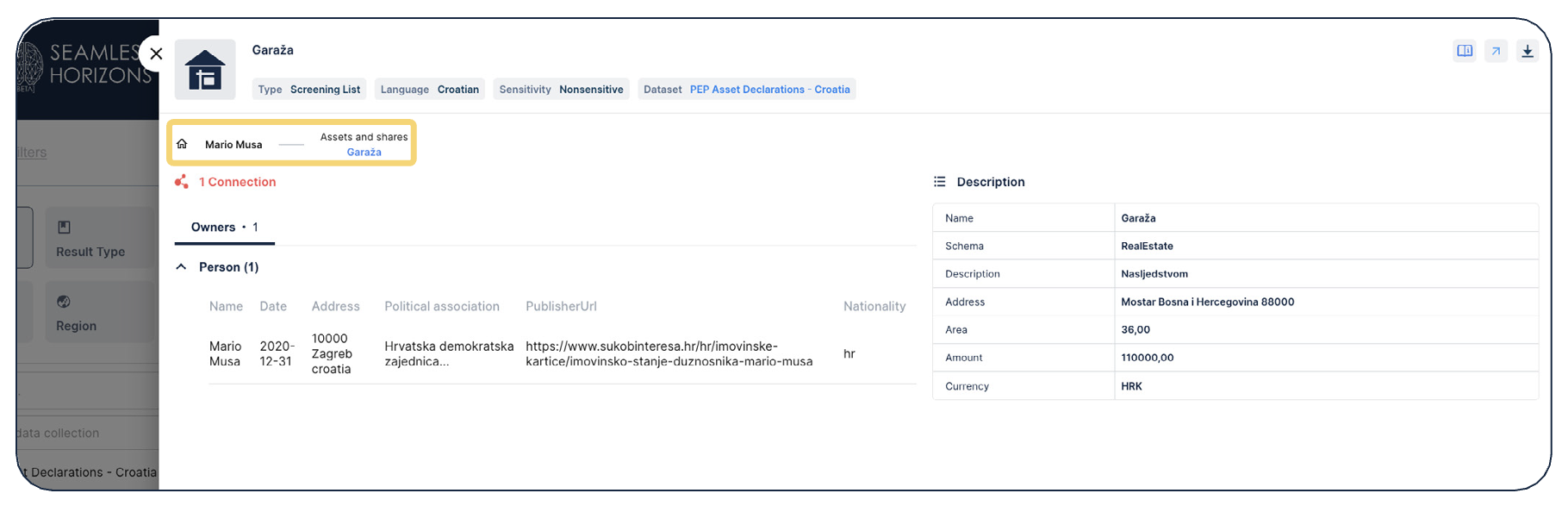
To return the PEP entity card, click on the PEP’s name in bold in the upper left corner. This chain is called a “breadcrumb trail”.
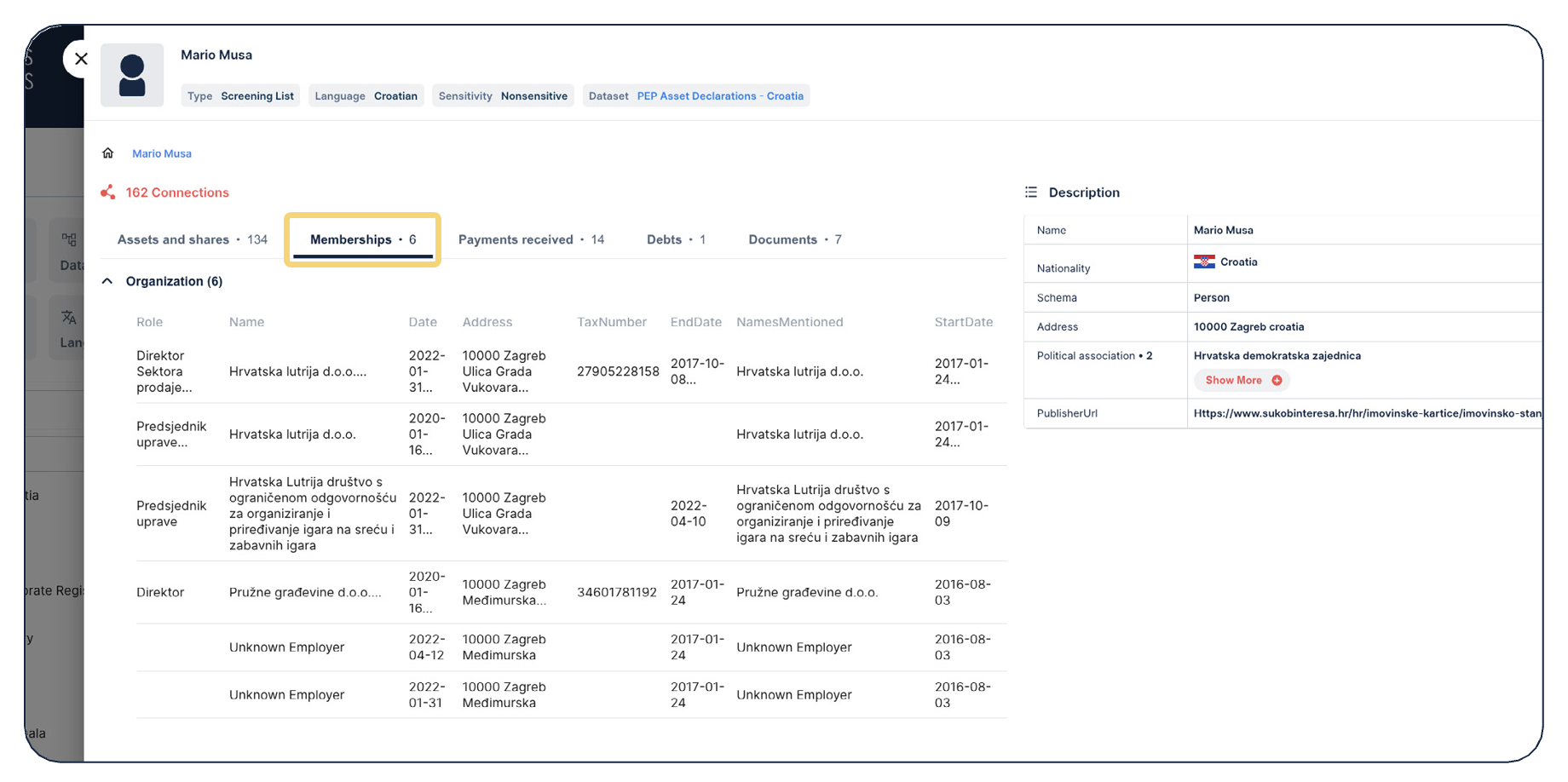
Click on the ‘Memberships’ tab. This allows you to view those political parties or companies for which the PEP has indicated an affiliation. You can see that Mario Musa has declared a position as Director of Pružne građevine d.o.o. in 2016, for example.
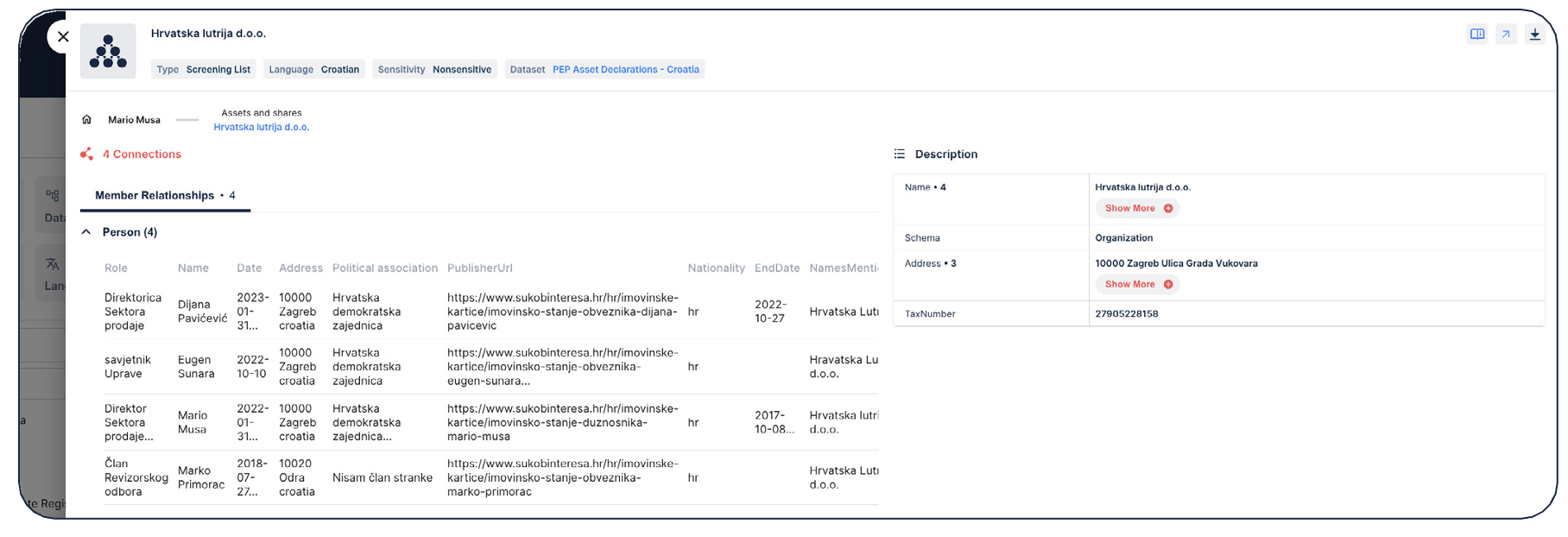
In those cases for which unique identifiers of corporations and legal entities have been made available, Horizons has also modeled individual corporations. In practice, this means that each field within the available corporate record is now searchable. Investigators can click on that modeled company and view whatever further information the record holds. For example, clicking on the ‘Hrvastka lutrija d.o.o.’ (the Croatian lottery) opens a new entity card for that company which contains information such as an address and a tax identification number. Investigators can also learn that 3 additional Croatian PEPs have declared a relationship with this entity. Without the modeled data in Horizons, investigators would have had to view four separate asset declarations to make this connection.
These connections are present outside of the PEP Environment as well. For example, if an investigator was independently searching for Hrvastka lutrija d.o.o., in Horizons, the entity’s relationships with these 3 PEPs would also surface.
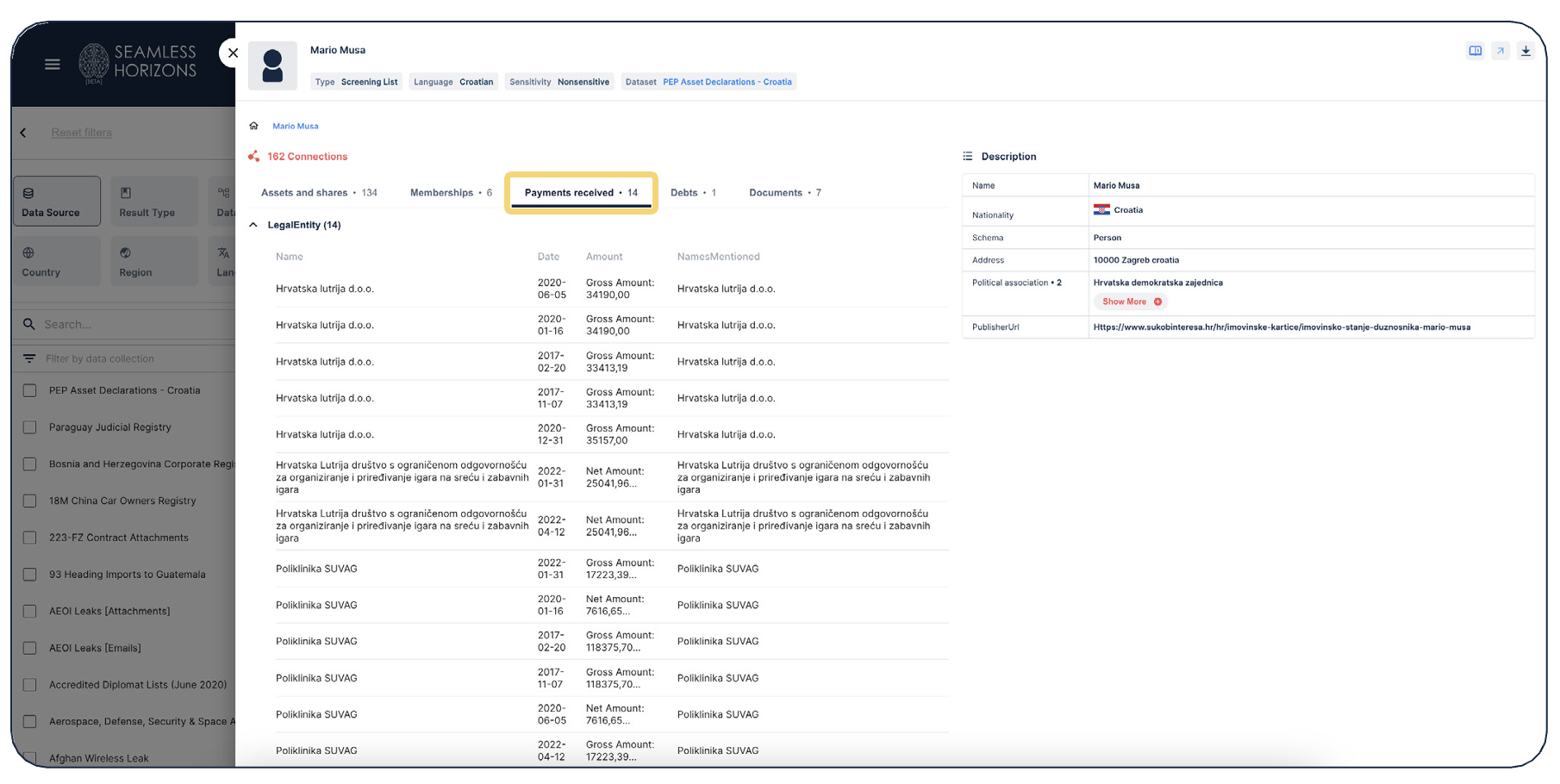
You can return to the original entity card by clicking on ‘Mario Musa’ in the breadcrumb trail, as practiced before. To see income that this PEP has declared from specific entities, you can click on the ‘Payments received’ tab. This allows you to see the income that the PEP has declared, giving investigators a sense of their declared wealth. In this example, Mario Musa has 14 declared incomes over the period of his asset declarations from three entities: Hrvatska lutrija d.o.o., Hrvatska Lutrija društvo s ograničenom odgovornošću za organiziranje i priređivanje igara na sreću i zabavnih igara, and Poliklinika SUVAG. Investigators should note that these first two names may be the same entity listed under differing names.
The ‘Assets and shares’ tab displays all assets and shares declared by Mario Musa to the Croatian government. These assets are grouped by type. For Mario Musa, four types of assets have been declared: real estate, cash assets, shares in companies, and vehicles. Musa has declared 134 total assets and shares. Paying close attention to this list will help investigators compare declared assets against potentially undeclared holdings that appear in Horizons.
To see more about each individual asset, select the icon to the left most side of each column.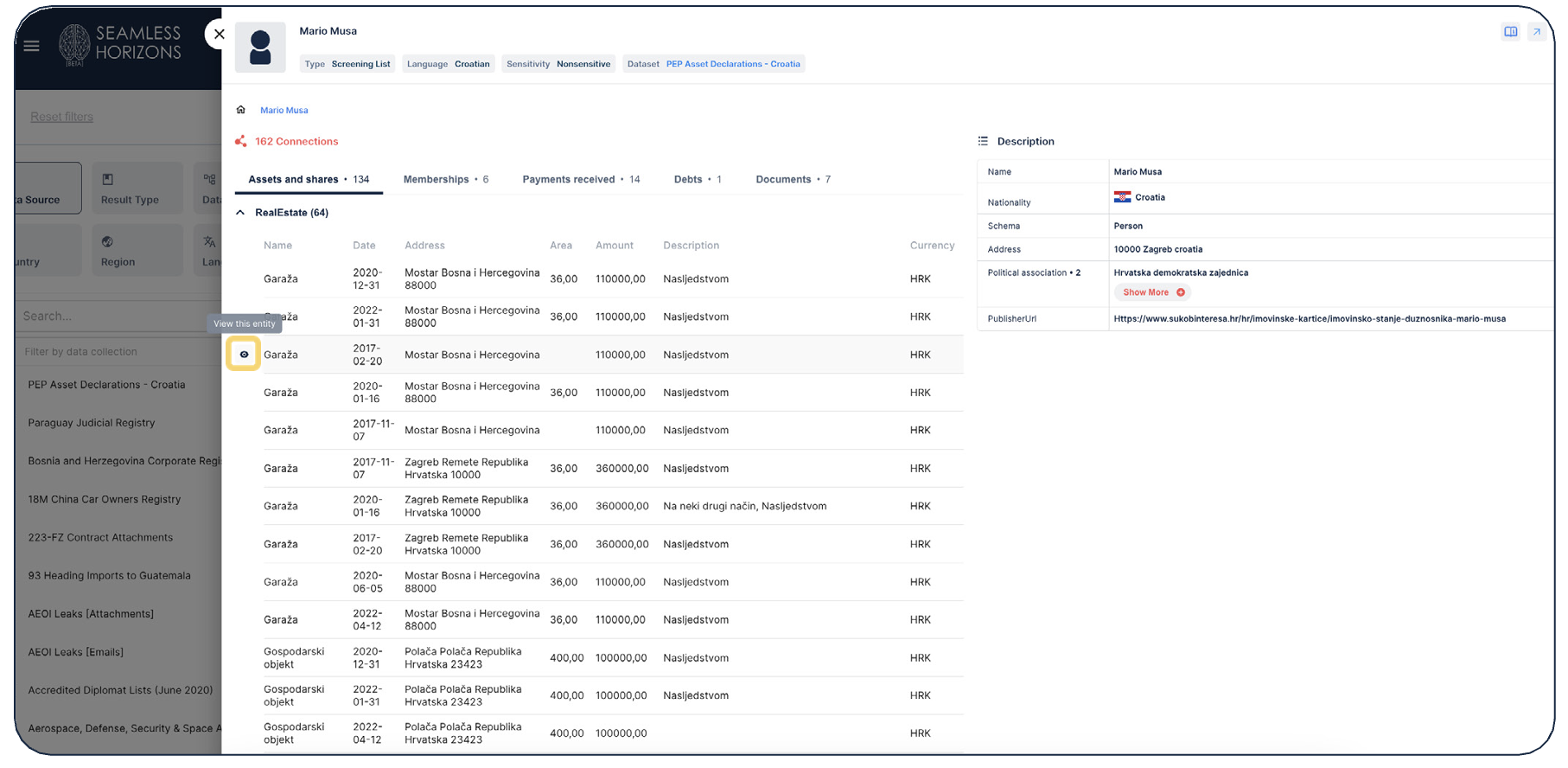
Each asset type contains unique details and descriptors.
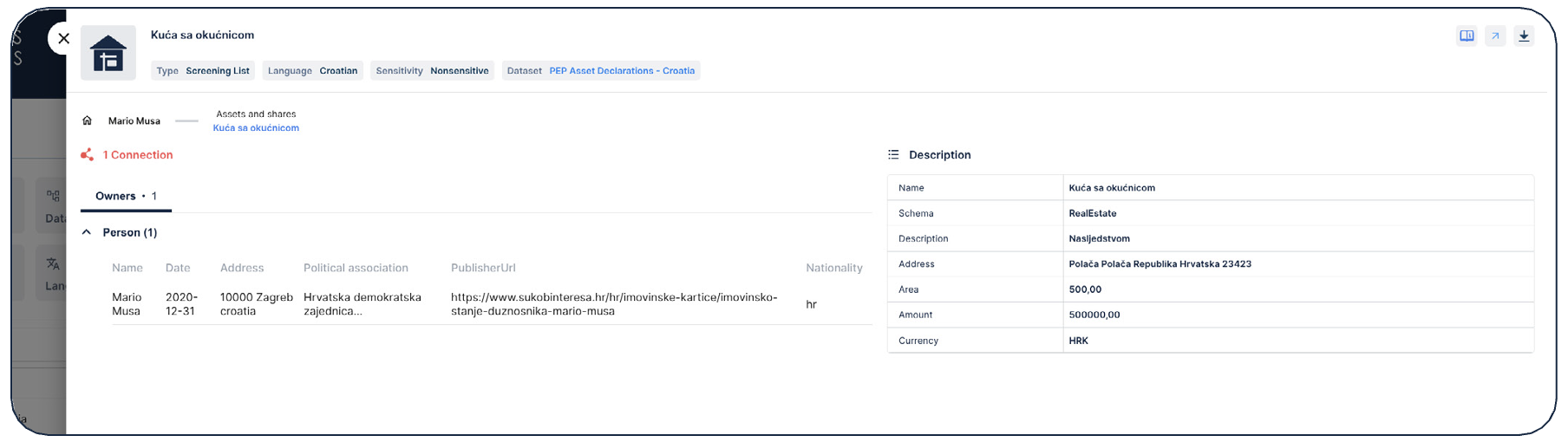
a. Real estate assets contain information on the type, address, area, declared value, and method of acquisition of the property. Here is a house with a garden declared by Musa located in Polača.
b. Cash assets contain information on the type, amount, currency, and method of acquisition of the asset. Below is a 1000 Swiss Franc asset declared by Musa in 2017.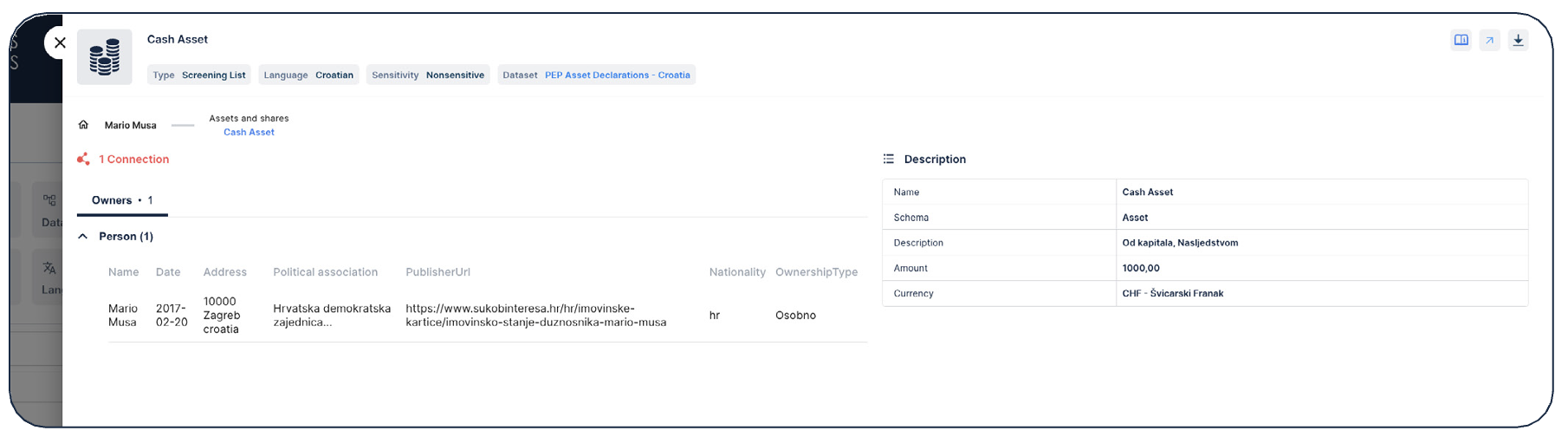
c. A company asset represents stakes or shares that a PEP has declared in a specific company. A company asset contains aliases of the company, all associated addresses, and its Croatian tax identification number. Clicking on a company listed as an asset in a PEP entity card will open up that company’s entity card. This allows you, for example, to see if other Croatian PEPs have declared a share or stake in this company. Mario Musa has declared 25 shares valued at 100 Croatian Kuna of Ericsson Nikola Tesla dd. Investigators can also see that Mario Musa has only declared relationships with Croatian and Bosnian companies, which is important to note for future investigations into asset ownership in other jurisdictions.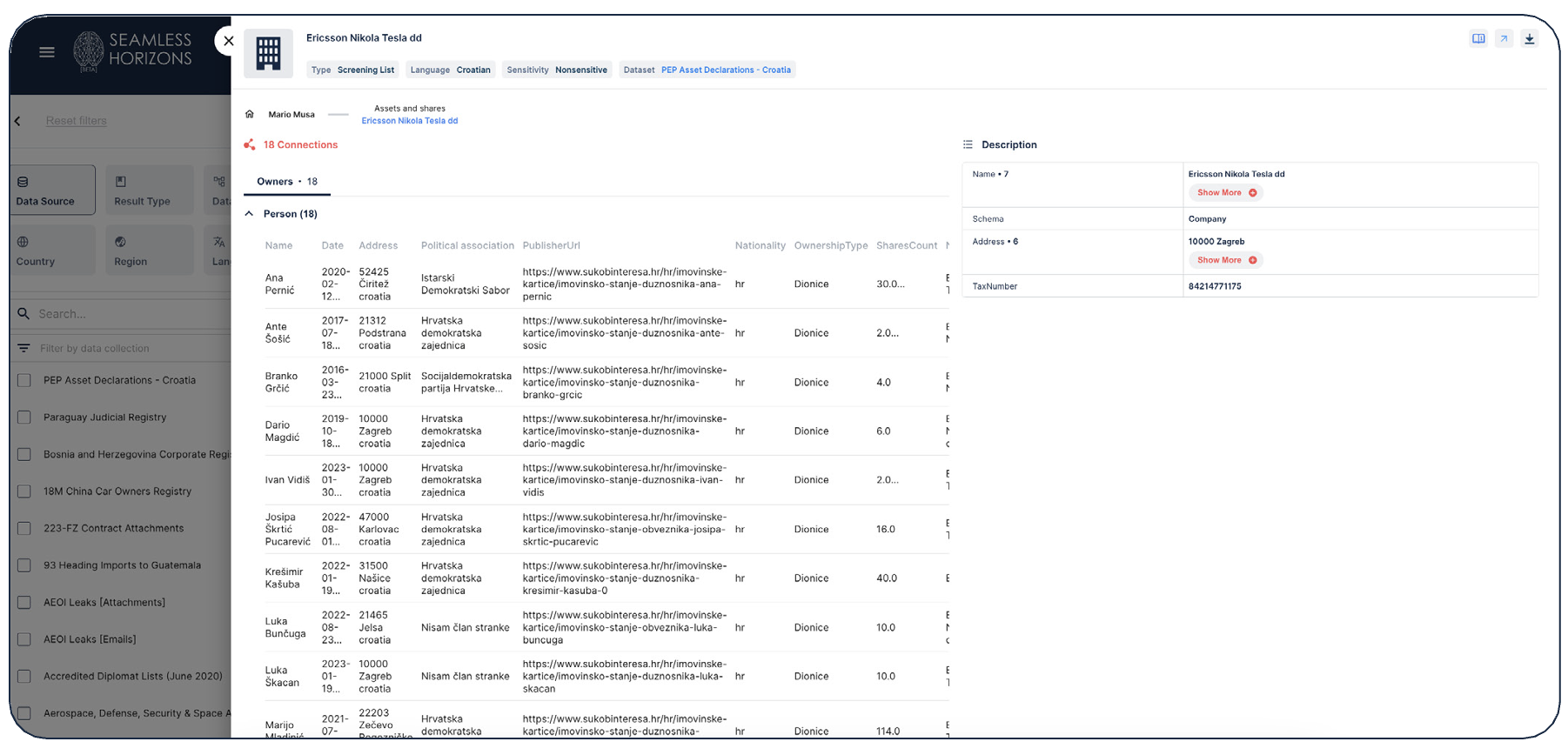
d. A vehicle asset contains information on the ownership, model, value, and method of acquisition of the vehicle.
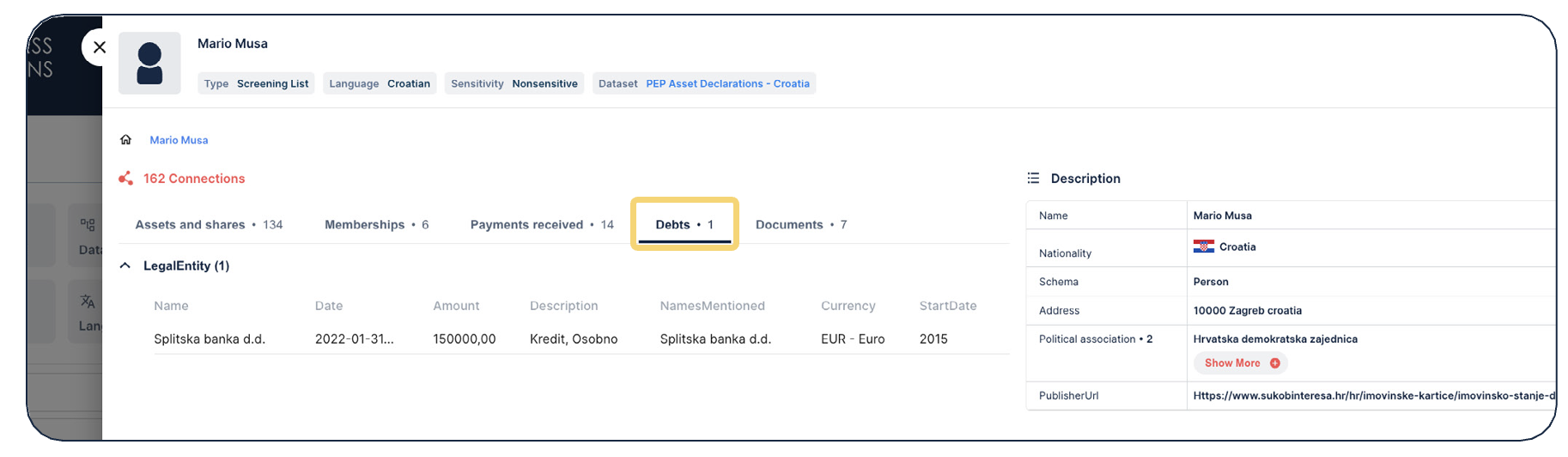
The ‘Debts’ tab contains information about any debt that the PEP has declared to the government. This tab contains the name of the lender, the value of the debt, and the start date of the loan.
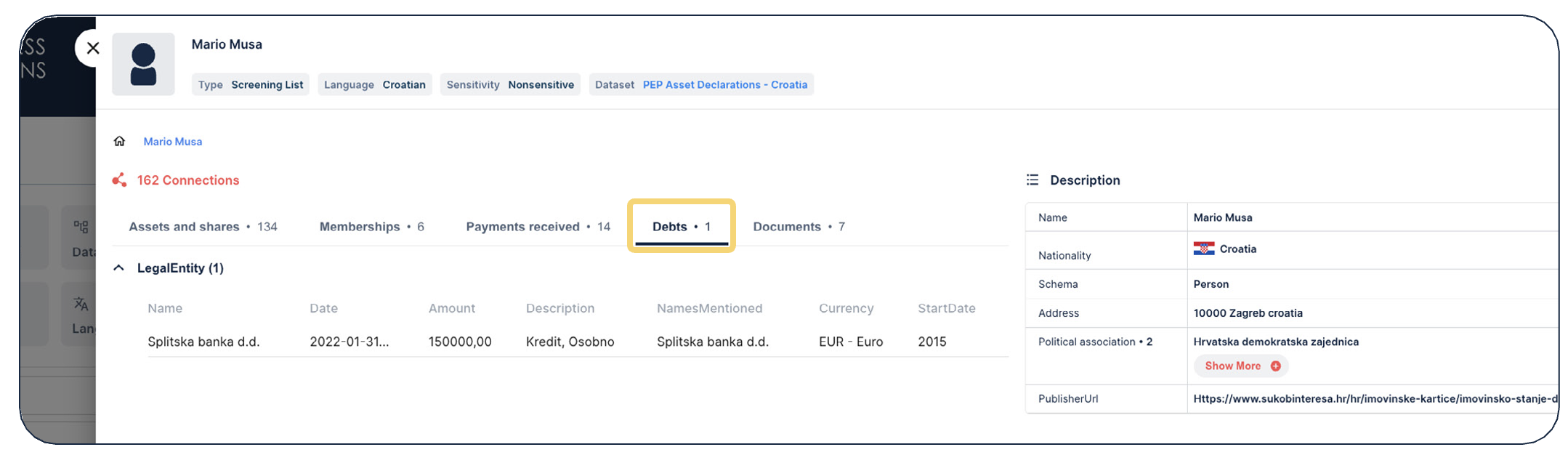
This asset declaration layout allows investigators to familiarize themselves with what the PEP has officially declared to their government.
Now, investigators can search across the broader Horizons environment to identify whether the PEP has undeclared wealth beyond this, either in their home country or in other jurisdictions. Investigators can do this by searching for the name of the PEP in a new tab, following the process below:
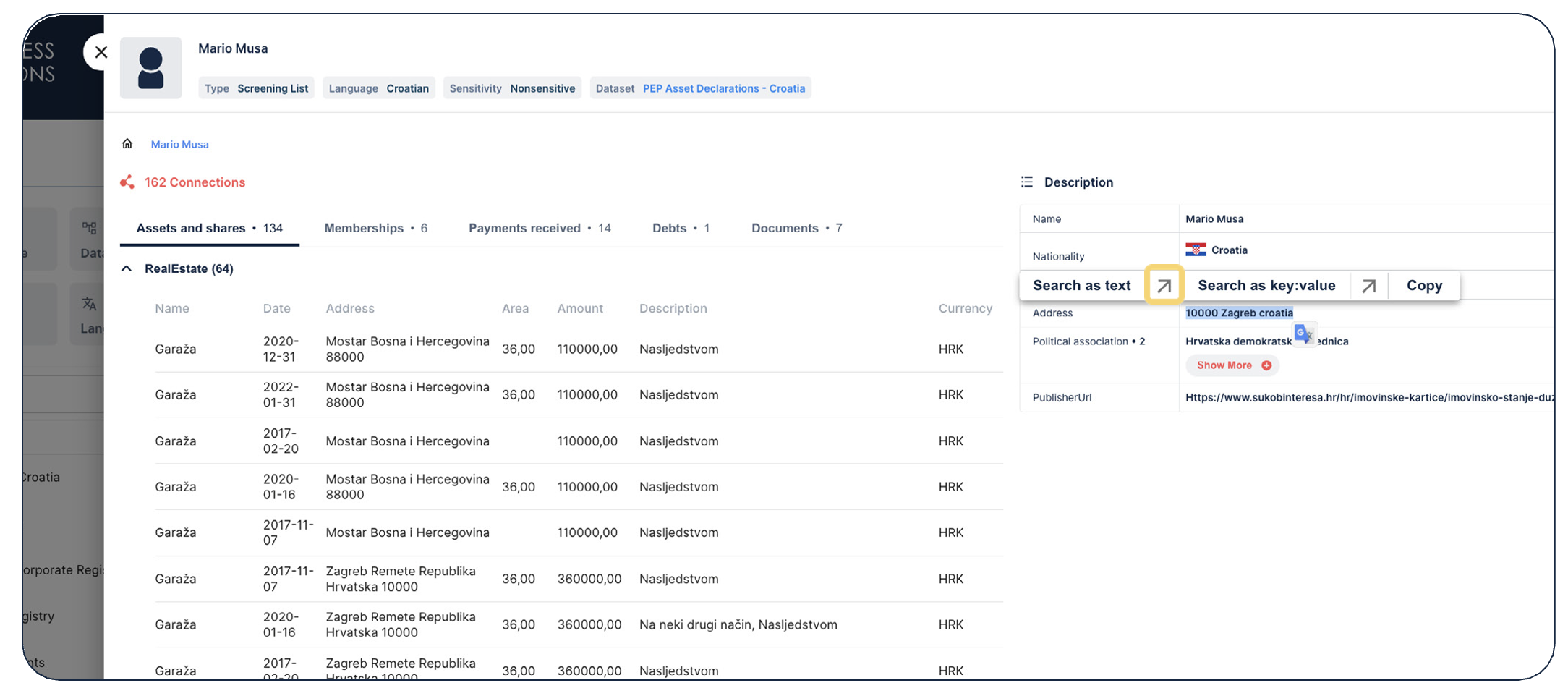
a. If you have encountered a term in your investigation that you would like to search in Horizons (an address, an alias, etc.), highlight this term and click the diagonal arrow which appears. This will open a new tab in Horizons which displays results for that specific search query. This functionality was created exclusively for this workflow to enable investigators to quickly query multiple relevant terms without losing their primary search and to toggle between multiple searches. By creating multiple tabs during an investigation on Horizons, investigators can more easily retrace their steps and recall how they encountered their findings, creating a continuous workflow on the platform.
Searching within this broader Horizons data lake is a useful step as PEPs often obfuscate ownership of their assets, hiding them with family or close associates. All of these individuals and their holdings can be searched within Horizons, allowing you the ability to investigate an entire network surrounding a PEP.
As we exit the PEP environment, we want to run searches that look for everything in Horizons except for these original records, with the goal of discovering potentially undeclared assets. To accomplish this, users can exclude these asset declarations. Click on the small box next to ‘PEP Asset Declarations- Croatia’ twice and ‘Apply’ to exclude the dataset. This exclusion filter was created specifically for this PEP workflow, to help investigators refine their searches across jurisdictions.
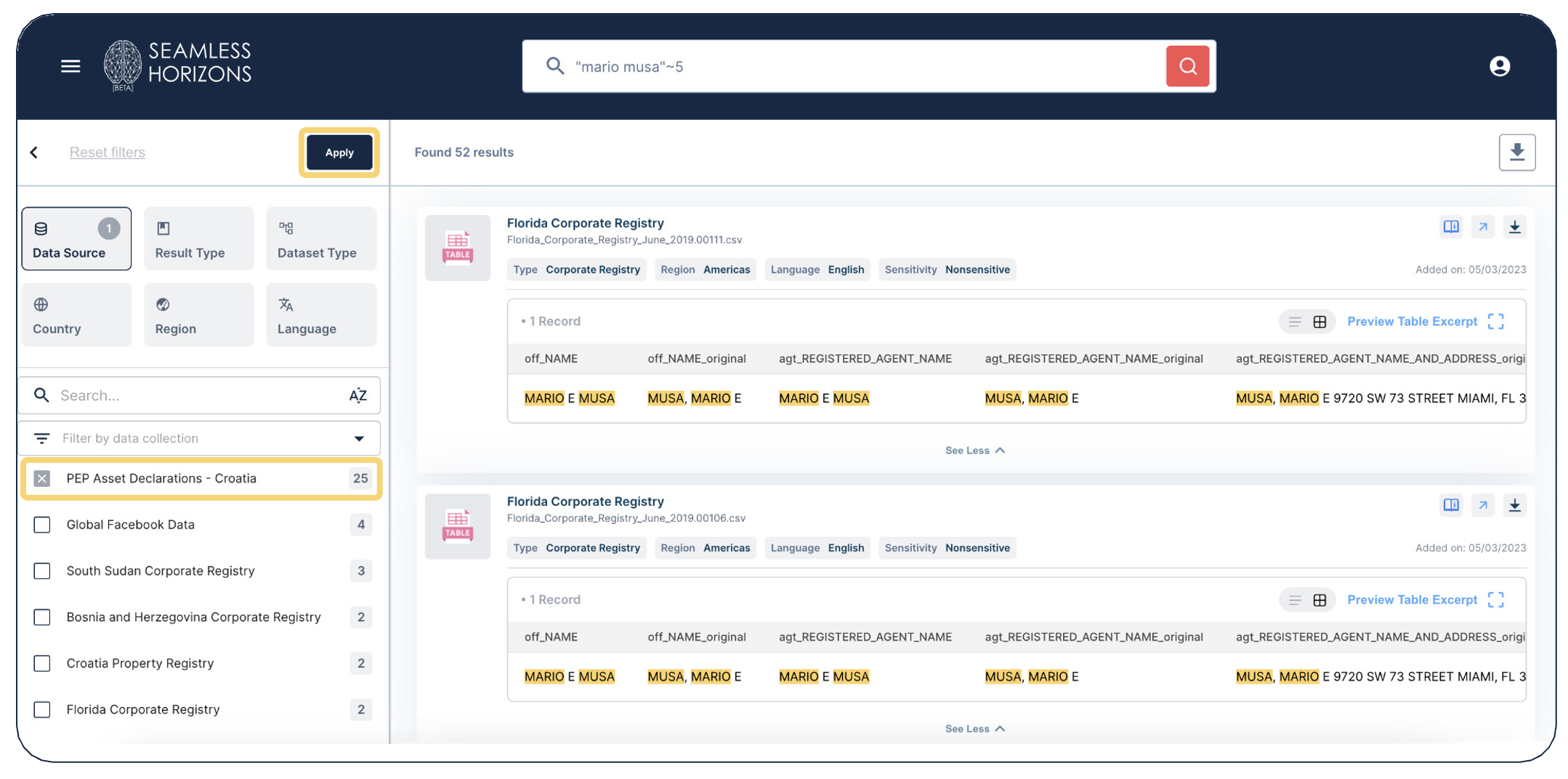
This search page shows 27 results for a fuzzy search of Mario Musa across Horizons while, at the same time, excluding his original asset declarations. We can scroll through our results to see if these results yield assets which were not declared on the Croatian declarations.
a. It is important to note that results from Horizons should not be considered more than a name match unless investigators can match additional identifiers (birth dates, national IDs, etc.).
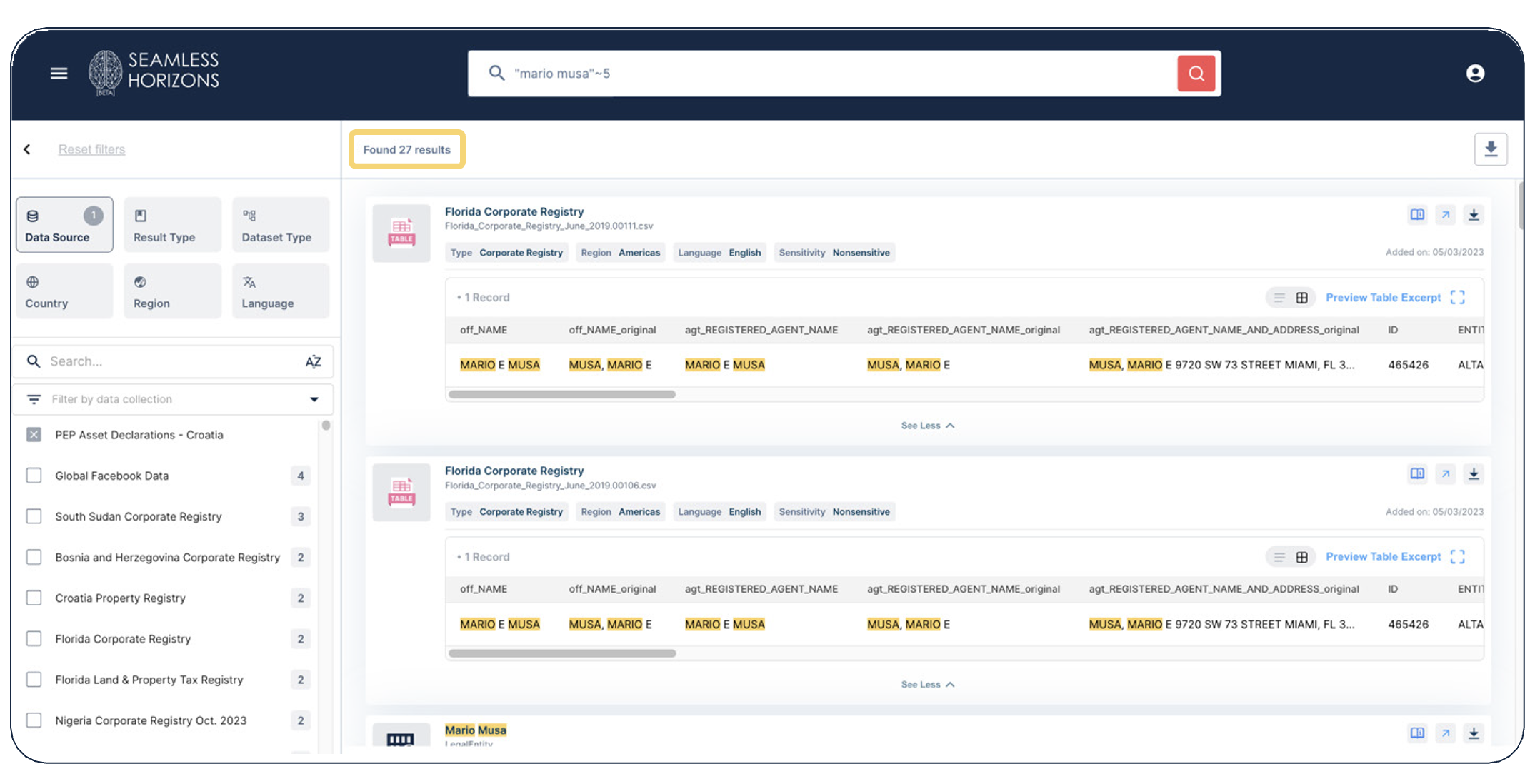
This leaves 27 results which are not directly correlated with the Croatian asset declarations, including across:
a. Eight countries, not including Bosnia or Croatia, where we were already aware that he owned assets. These countries include the United States of America, South Sudan, Nigeria, Paraguay, South Africa, El Salvador, Mexico, and Switzerland.
b. Seven regions, including North America, South America, Central America, Europe, East Africa, West Africa, and Southern Africa,
c. Four different result types, including CSVs, PDFs, persons and documents.
Investigators can check across these results for other potentially undeclared assets of Croatian PEP Mario Musa.
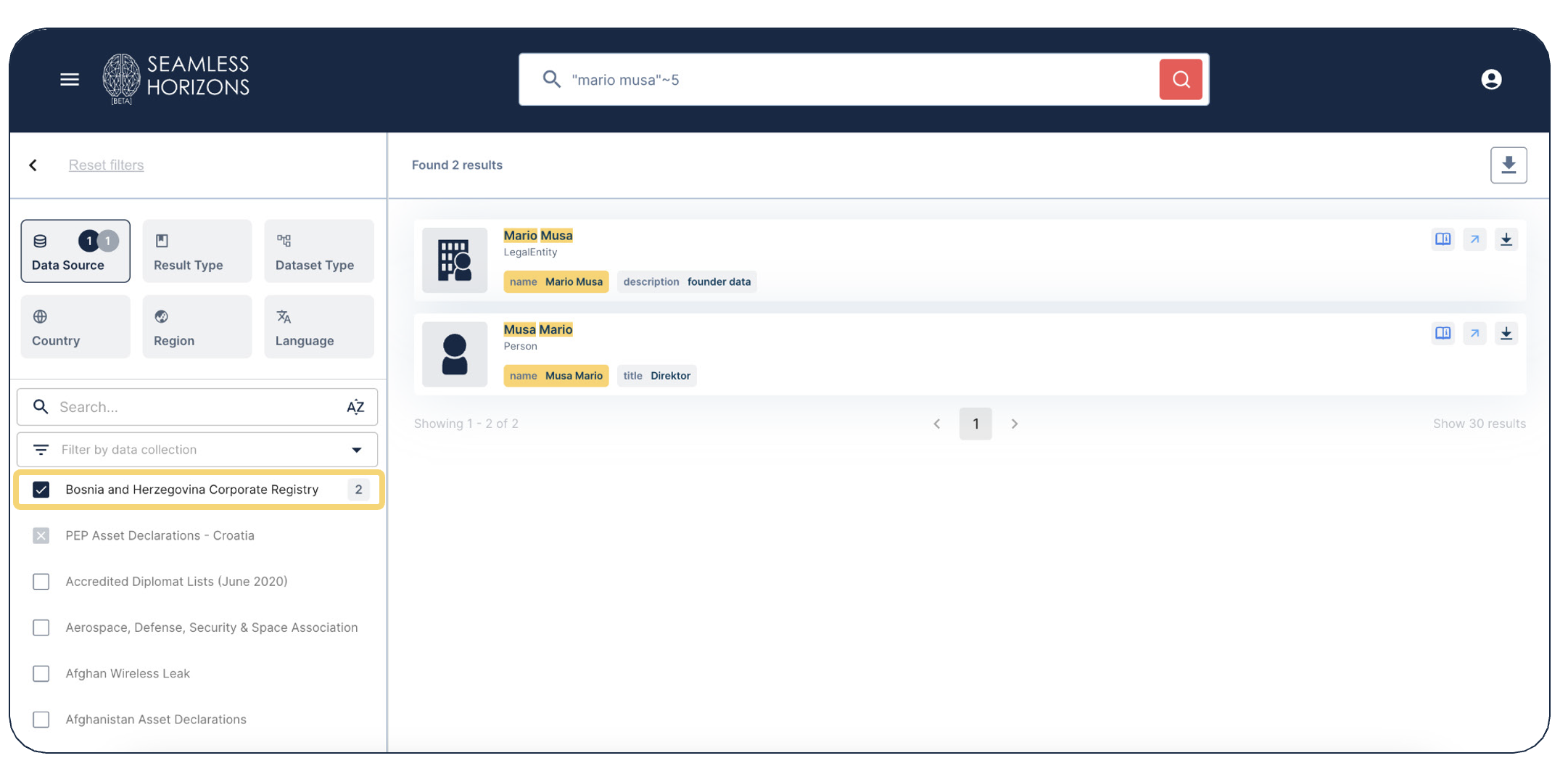
To look at just one of these datasets, click once on the box beside the dataset you wish to view and press ‘Apply.’
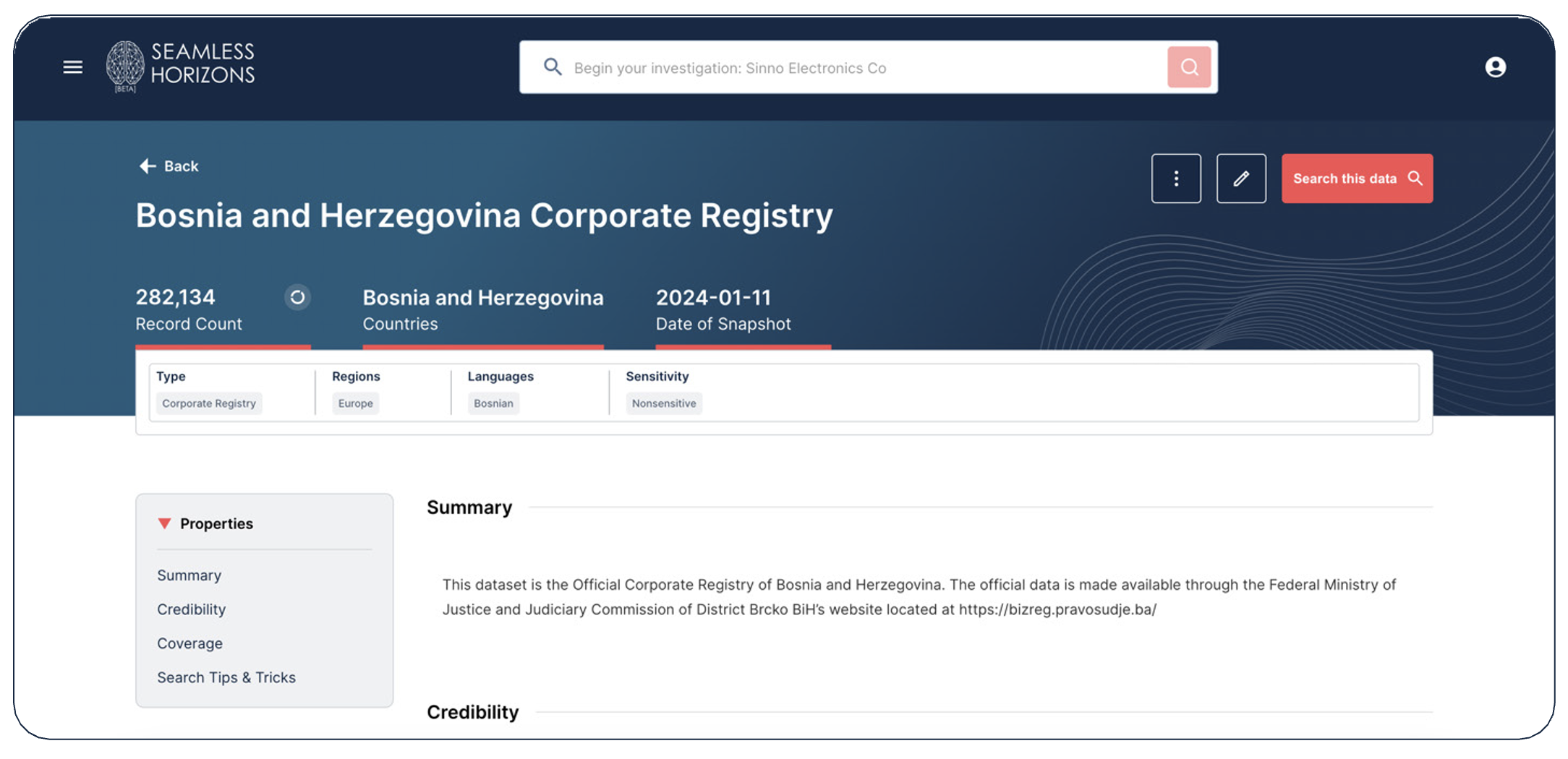
To assess the validity of these datasets and understand what they comprise and when they were collected, you can view them in the C4ADS data dictionary. To navigate to the data dictionary of a given result, click on the blue book icon in the upper right-hand corner of the line item. The data dictionary contains a summary of the dataset, as well as general information about its credibility, coverage, and search tips & tricks.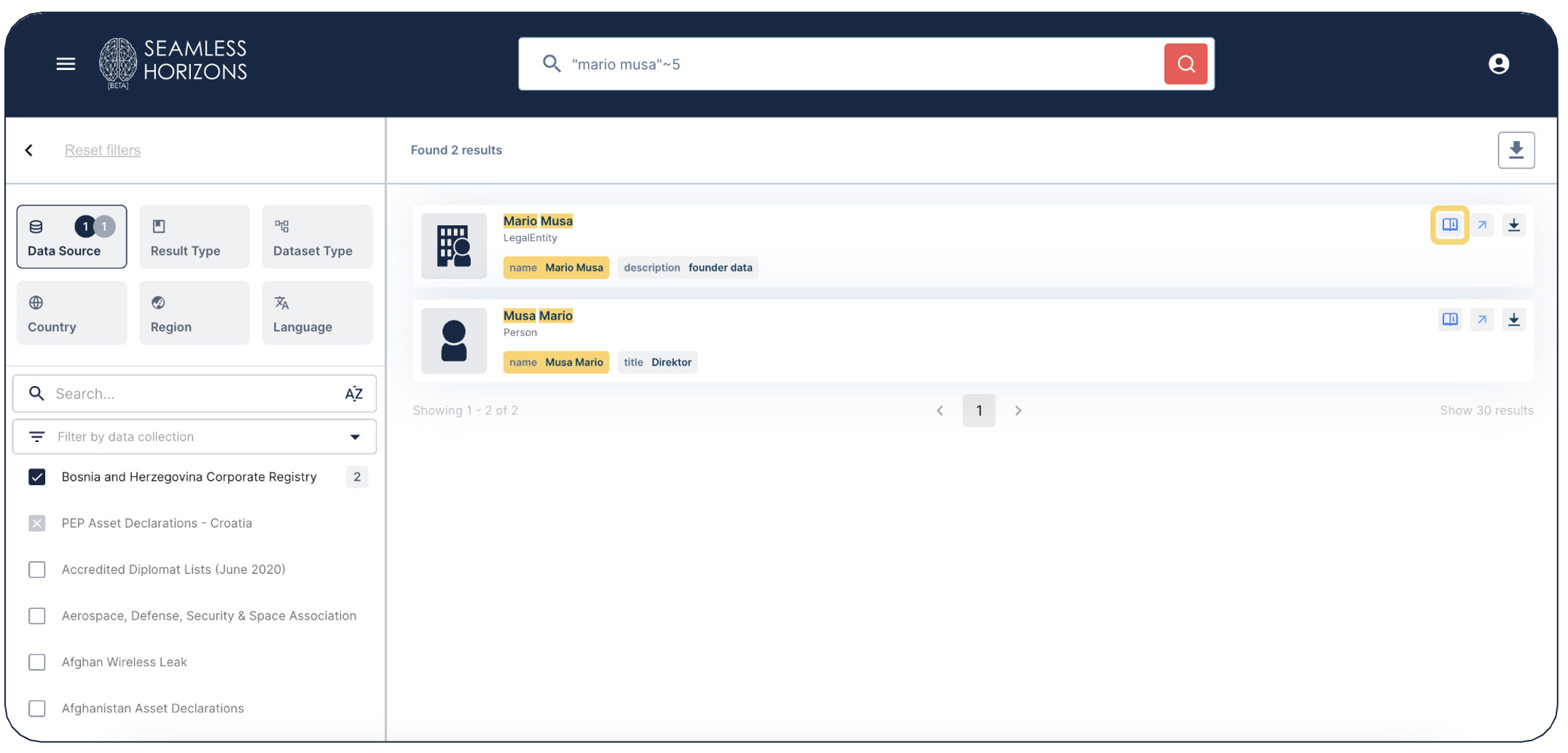
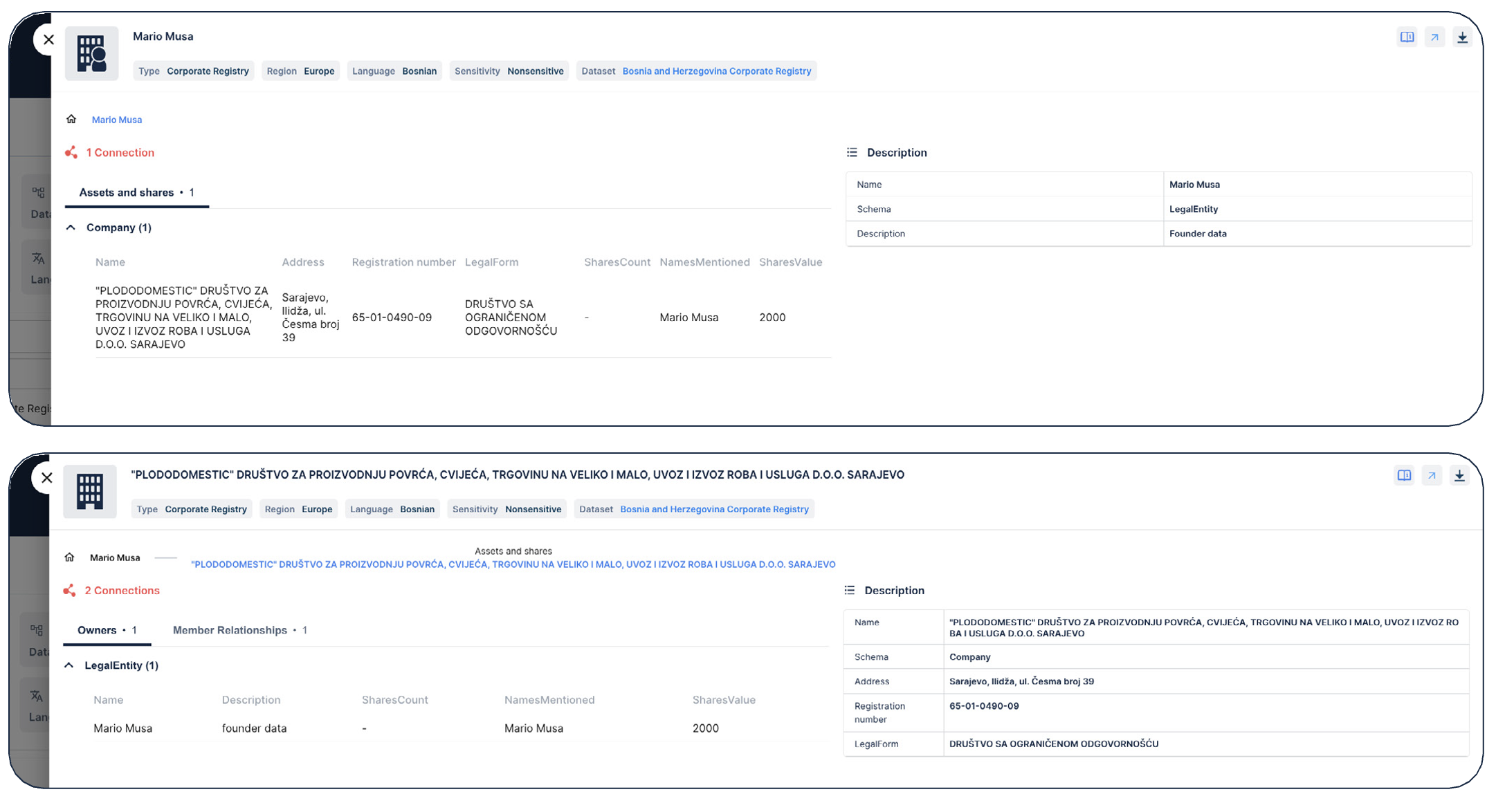
The Bosnia and Herzegovina Corporate registry shows that an individual named Mario Musa appears as a director of a company registered in the country. Clicking on the first result shows the name of the company, “PLODODOMESTIC” DRUŠTVO ZA PROIZVODNJU POVRĆA, CVIJEĆA, TRGOVINU NA VELIKO I MALO, UVOZ I
IZVOZ ROBA I USLUGA D.O.O. SARAJEVO.” According to the corporate registry, this Mario Musa holds shares in the company, which are valued at 2000 Bosnian marks. An address and business registration number are provided, both of which are strong identifiers to continue an investigation across and potentially outside of Horizons. This company does not appear on Mario Musa’s asset declarations, so if further entity verification can prove that Croatian PEP Mario Musa is the same business director registered in Bosnia, this company would be considered an undeclared asset.
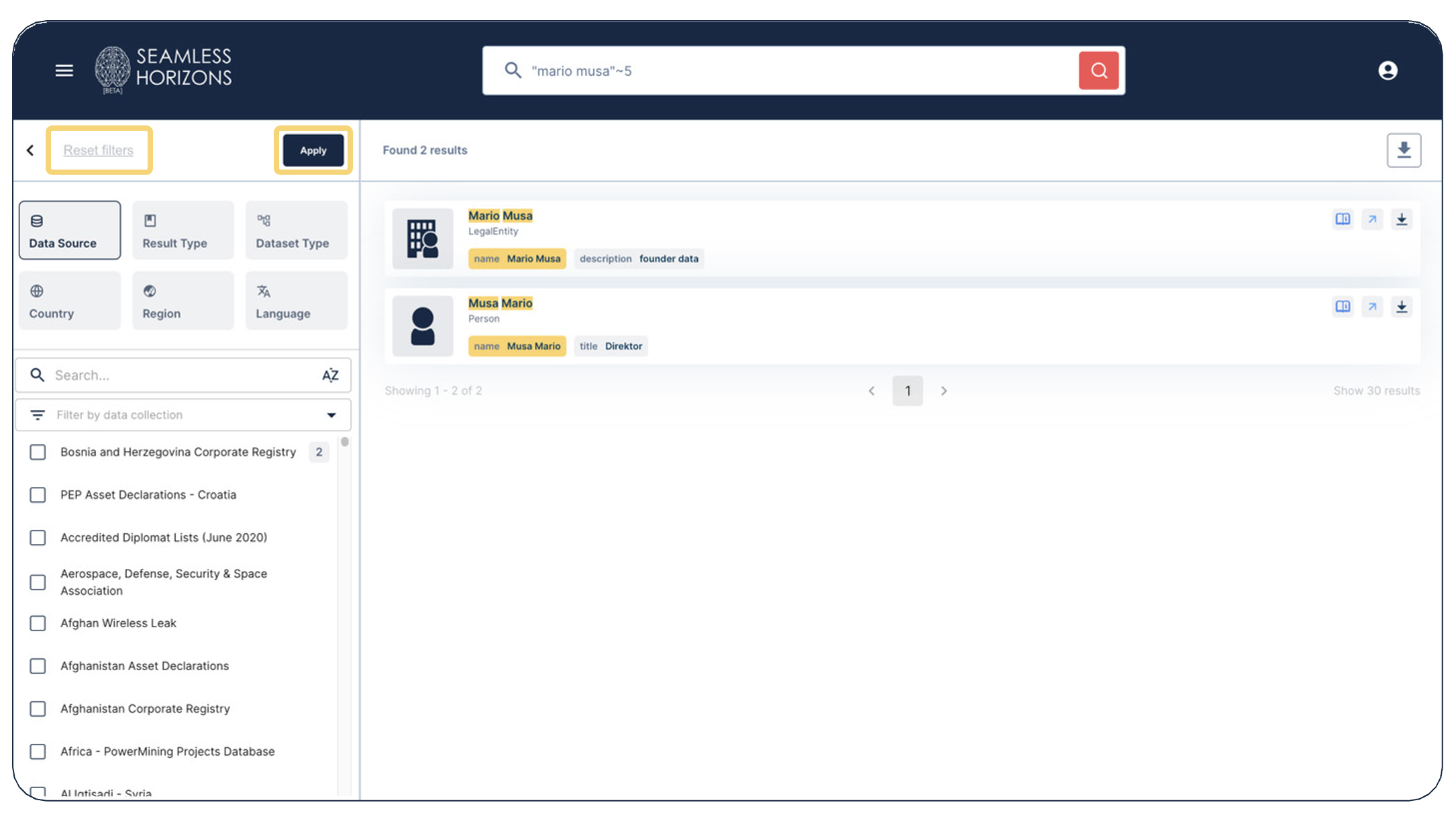
If you have exhausted your search in the Bosnian Corporate Registry, you can click ‘Reset filters’ and ‘Apply’ to see the original 27 search results.
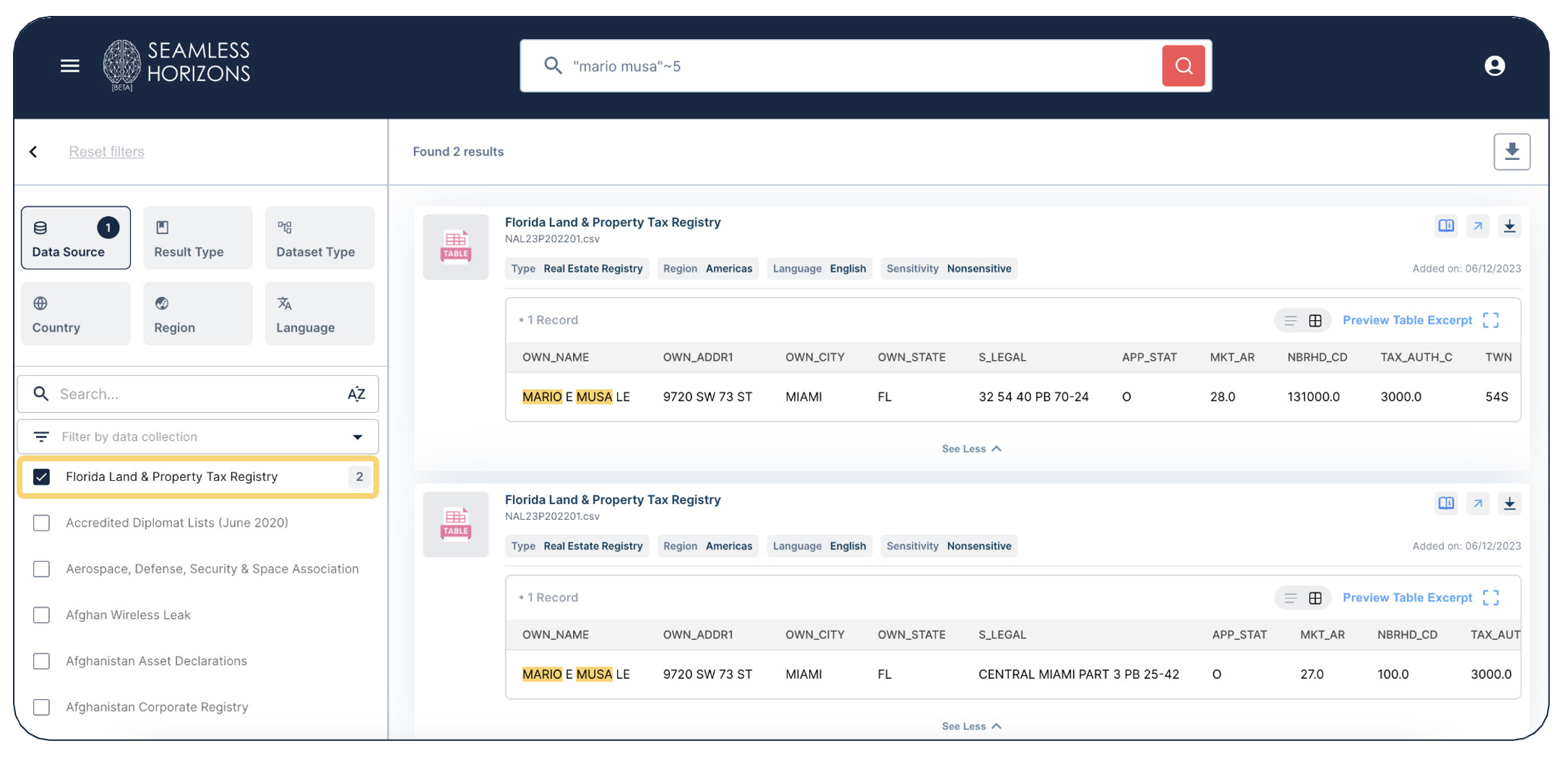
Let’s now check results in the Florida Land & Property Tax Registry. Click once on this dataset to filter for these results. Horizons shows a Mario E Musa Le owning a property in Miami, Florida. This dataset contains several useful identifiers, including an address, a parcel number, the value of the land, and the size of the property. This property does not appear on Mario Musa’s asset declarations, so if further entity verification can prove that Croatian PEP Mario Musa is the same property owner registered in Florida, this house would be considered an undeclared asset.
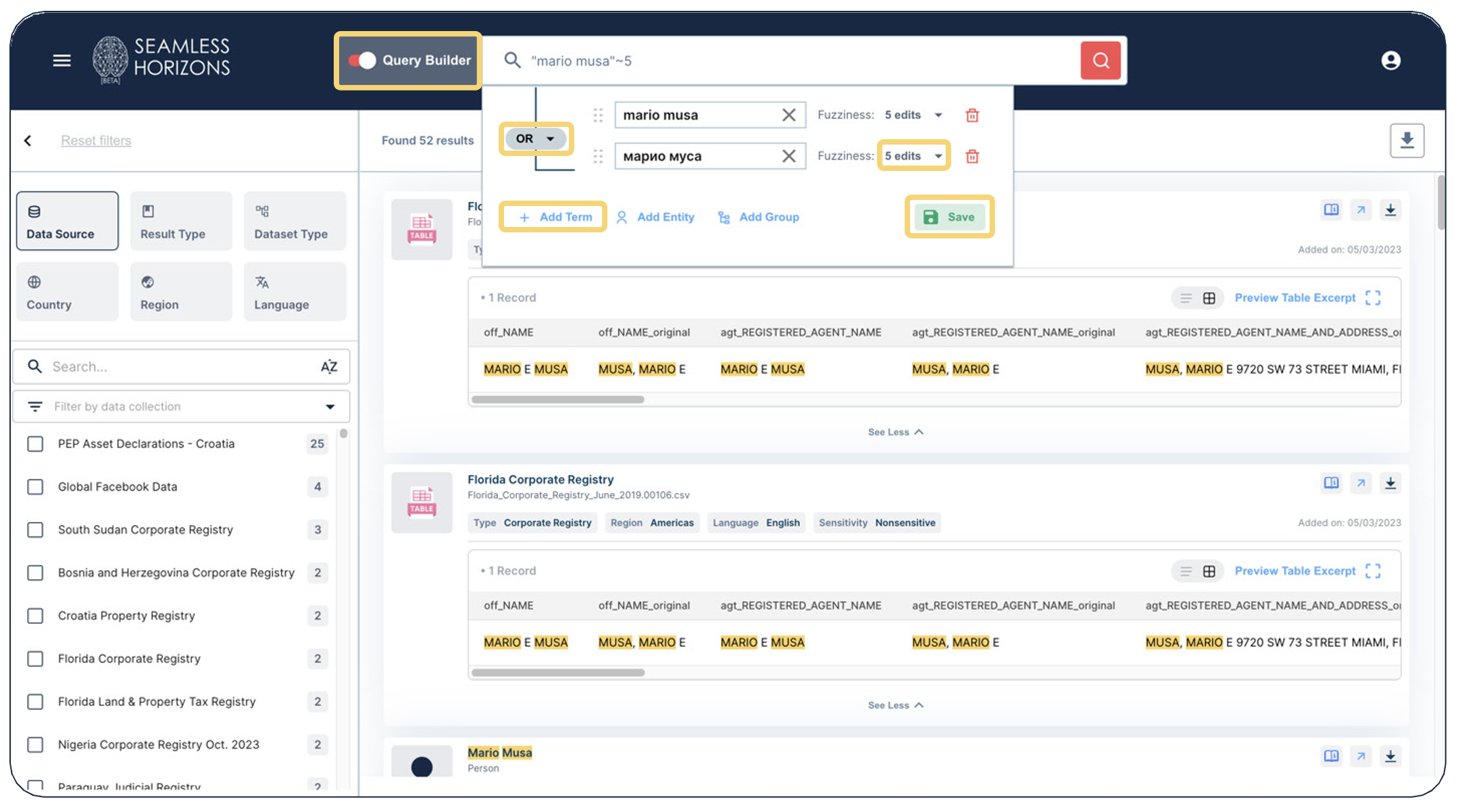
If investigators wish to search multiple terms in tandem with one another, they can use Horizon’s query builder. This query builder is particularly useful when searching for results that may have been transliterated. For this example, we’ll search Mario Musa in Cyrillic.
Click on the toggle button on the left hand of the search bar to turn on Query Builder. You can then click “Add term” to search multiple terms at a time. The ‘AND’ command will yield only results where all of your terms are mentioned, and the ‘OR’ command will yield results where any of your terms are mentioned.
Type in your additional term and select your desired fuzziness. Click the green “Save” button to save this search. Click the red search arrow to return results for your new query.
Outside of Bosnia and Herzegovina and Florida, Horizons shows results for Mario Musa across several other jurisdictions, including South Sudan, Nigeria, Paraguay, South Africa, El Salvador, Mexico, and Switzerland. Investigators can check across these results for other potentially undeclared assets of Croatian PEP Mario Musa. It is important to note that Horizon’s data holdings are always expanding, so investigators should periodically check the platform for new results.
Conclusion
This methodology is designed to help investigators identify undeclared wealth held by PEPs. Although name matches should always be checked against other possible identifiers, the Horizons PEP Workflow is a strong starting point for any investigation into unexplained and undeclared wealth.